
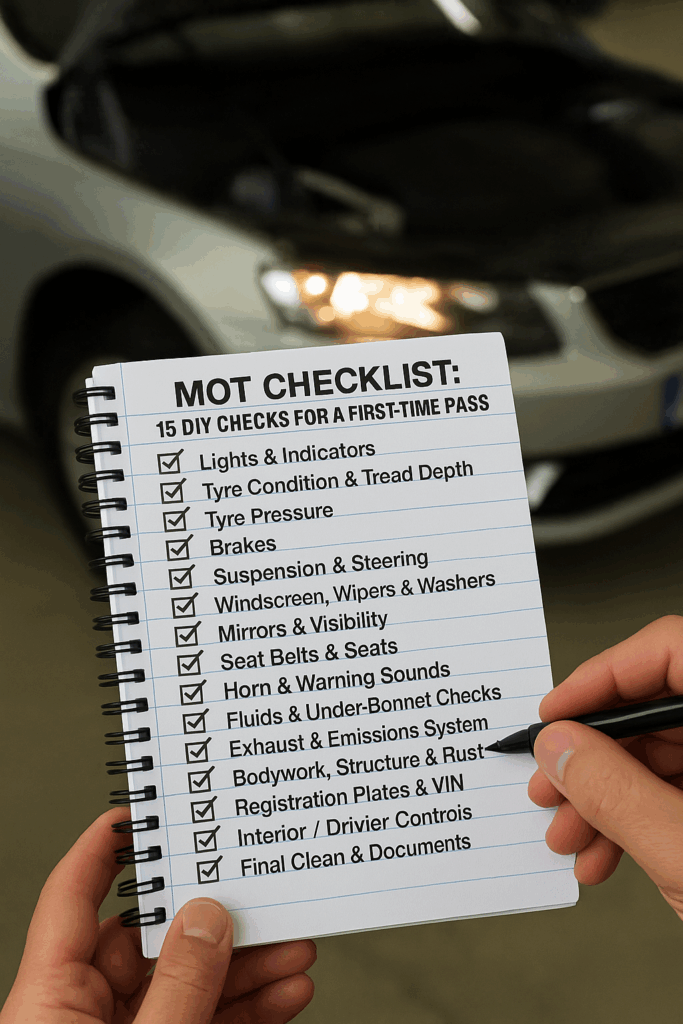
A good pre-MOT checklist takes about 10 minutes and can catch plenty of faults before the tester does. Check your lights, tyres, wipers, number plates, seat belts and the other basics below, then get anything doubtful looked at before the test.
Not sure when your MOT is due? Put your registration into the MOT checker on https://www.windmillgarage.co.uk/ and you can check in seconds.
[FEATURE FOR CHRIS: printable PDF checklist download goes here. One-page version of the 15 checks below, free to download with no email required.]
Your 15-point pre-MOT checklist
You do not need to be a mechanic for these checks. Most need nothing more complicated than walking around the car, switching something on or having a good look.
They cannot guarantee a pass. An MOT tester checks far more than you can sensibly inspect on the driveway, including areas underneath the car and the performance of safety-critical systems. But this list will help you catch the straightforward stuff first.
1. Check every light and indicator
How to check it: Switch on the sidelights, dipped and main-beam headlights, indicators, hazards, rear lights and rear fog light. Ask someone to watch the brake lights while you press the pedal, or use a reflection from a window or garage door.
Check the lenses too. They should be secure and not so damaged, dirty or obscured that the light is affected.
Fail or advisory? A required lamp that does not work can be a major defect and mean an MOT fail. The exact result depends on which lamp is affected and the nature of the defect.
More detail: https://www.windmillgarage.co.uk/mot/horn-lights-wipers-small-faults-big-mot-fails/
2. Check your tyre tread
How to check it: Look across each tyre and check the tread around its full circumference. For most cars, the legal minimum is 1.6 mm across the central three-quarters of the tyre’s breadth and around the entire circumference.
A tread-depth gauge gives you a proper measurement. The familiar 20p check can be a useful quick warning, but it is not a substitute for measuring if the tyre looks close to the limit.
Also look for cuts, lumps, bulges or exposed cords.
Fail or advisory? A tyre below the legal tread limit is a major defect. Certain serious tyre defects can be classed as dangerous. Wear that remains legal may be recorded as an advisory.
Our tyre tread guide goes into this in more detail: https://www.windmillgarage.co.uk/tyres/tyre-tread-depth-hacks-for-a-sure-mot-pass/
3. Check tyre pressures and the TPMS warning
How to check it: Set your tyre pressures to the manufacturer’s figures, normally found in the handbook, fuel flap or door area. Then check that the tyre-pressure monitoring system, if your car has one, is not showing a fault warning.
Fail or advisory? Tyre pressure itself is not a simple pass-or-fail measurement in the way tread depth is, but an obviously under-inflated tyre can indicate a problem and tyres must remain safe. A malfunctioning tyre-pressure monitoring system on a vehicle where it is testable can be a major defect.
4. Give the brakes a sensible check
How to check it: On a normal drive, pay attention to how the brakes feel. Grinding, pulling to one side, excessive pedal travel or a brake warning light all deserve attention. Make sure the parking brake holds the car properly too.
Do not crawl underneath or dismantle anything for the sake of a DIY MOT check. Brakes are one of the jobs where knowing when to stop checking and start asking is useful.
Fail or advisory? Brake defects range from minor observations to major and dangerous faults, depending on severity. If something feels wrong, have it checked rather than waiting for the MOT.
See our pre-MOT brake guide: https://www.windmillgarage.co.uk/mot/brake-check-basics-diy-pre-mot-safety-steps/
5. Listen to the steering and suspension
How to check it: Notice any knocking, clunking or unusual movement when turning the steering wheel or driving over bumps. Look at the car from each side for an obvious lean or unusually low corner.
Fail or advisory? Excessive wear, insecurity or other serious steering and suspension faults can mean a fail. Lesser deterioration may be recorded as an advisory.
Suspension remains one of the bigger MOT problem areas. In DVSA figures for April to June 2025, suspension defects appeared in 8.65% of Class 3 and 4 initial tests.
More on what to look for: https://www.windmillgarage.co.uk/mot/steering-suspension-red-flags-before-your-mot/
6. Check the windscreen
How to check it: Sit in the driver’s seat and look through the area swept by the wipers. Check for cracks, chips, stickers, phone mounts or anything else that significantly affects your view.
Fail or advisory? Windscreen damage or an obstruction can be a major defect if it significantly affects the driver’s view. Smaller damage outside critical areas may not fail the MOT.
If the tester cannot see the road properly, neither can you. Worth sorting.
7. Test the wipers and washers
How to check it: Switch the washers on and make sure fluid reaches the windscreen. Run the wipers and check that they clear the screen properly without damaged blades leaving the driver’s view obscured.
Top up the screenwash before the test if it needs it.
Fail or advisory? Wipers that cannot clear the windscreen sufficiently for the driver to see ahead can be a major defect. A washer system that does not provide enough fluid to clear the screen can also fail.
More detail: https://www.windmillgarage.co.uk/mot/horn-lights-wipers-small-faults-big-mot-fails/
8. Check your mirrors and view of the road
How to check it: Make sure the required mirrors are present, secure and usable. Remove anything from the windscreen or front side windows that seriously restricts your view.
Fail or advisory? A required mirror that is missing, insecure or does not provide an adequate view can result in a fail, depending on the vehicle and defect.
9. Check every seat belt
How to check it: Pull each fitted belt out and inspect the webbing for obvious cuts or serious damage. Fasten each buckle, give the belt a firm pull and make sure it locks and releases correctly.
Fail or advisory? An obligatory seat belt that is missing, insecure or sufficiently damaged can be a major defect. Some restraint-system faults can also result in an MOT failure.
Our fuller seat belt check is here: https://www.windmillgarage.co.uk/mot/seatbelt-safety-checks-easy-pass-tips/
10. Press the horn
How to check it: Press it. That is pretty much the whole DIY procedure.
The horn needs to work and give a suitable continuous, uniform sound. Musical renditions are best left elsewhere.
Fail or advisory? A required horn that does not work, or is not suitable, can be a major defect.
See the lights, horn and wipers guide: https://www.windmillgarage.co.uk/mot/horn-lights-wipers-small-faults-big-mot-fails/
11. Look at the dashboard warning lights
How to check it: Start the car normally and watch the dashboard. Pay particular attention to warning lights for systems such as ABS, airbags, electronic stability control and the engine management system.
Do not simply clear a warning light immediately before the test and hope for the best. If it is reporting a fault, find out why.
Fail or advisory? Certain warning lamps showing a system malfunction are specifically tested and can mean a major defect. The rules vary according to the system, vehicle and date of first use.
12. Check for fluid and exhaust leaks
How to check it: Look underneath where the car has been parked for signs of a significant fresh leak. With the engine running, listen for an exhaust that suddenly sounds much louder than normal and look for excessive visible smoke.
Check the engine oil level too. An MOT emissions test may not be carried out if the engine is not in a suitable condition to test safely.
Fail or advisory? A fluid leak can be minor, major or dangerous depending on what is leaking and how serious it is. Exhaust and emissions faults can also cause a fail.
If you have spotted oil underneath the car, read: https://www.windmillgarage.co.uk/mot/oil-leaks-vs-mot-what-counts-as-a-fail/
13. Check the bodywork, doors, bonnet and boot
How to check it: Walk around the car looking for loose panels, serious corrosion and dangerous sharp edges. Check that the driver’s and passenger doors open and close properly, and that the bonnet catches securely.
Fail or advisory? Serious corrosion or structural weakness in prescribed areas can result in a major or dangerous defect. Unsafe doors, catches or sharp bodywork can also fail depending on severity and location.
Surface rust is one thing. Structural corrosion is another.
14. Clean and inspect the number plates
How to check it: Make sure the front and rear registration plates are present where required, securely fitted, clean and easy to read. Look for damage, incorrect spacing or anything that makes the registration difficult to identify.
Fail or advisory? A missing, insecure or non-compliant registration plate can be a major defect. Other plate defects may be minor depending on the issue.
More detail: https://www.windmillgarage.co.uk/mot/number-plate-compliance-fast-mot-win/
15. Do one final walk-round
How to check it: Before leaving for the test, walk around the car once more. Clean the lights, glass and number plates, remove anything obstructing the driver’s view and think back to any previous MOT advisories you have not dealt with.
You do not need to turn up with a boot full of paperwork for a routine MOT. What matters is that the vehicle can be identified and safely tested.
Fail or advisory? There is no MOT defect called “forgot the final walk-round”. This last check simply gives you one more chance to spot something obvious before we do.
What does the full MOT test check?
The MOT is considerably more detailed than this DIY checklist. It checks whether the vehicle meets the required road safety and environmental standards on the day of the test.
Depending on the vehicle, that includes areas such as:
- registration plates and vehicle identification
- brakes
- steering
- visibility, windscreen, washers and wipers
- lamps, reflectors and electrical equipment
- axles, wheels, tyres and suspension
- body, structure and attachments
- seat belts, airbags and other safety equipment
- horn
- exhaust noise, emissions and fluid leaks
So a clean sweep through these 15 checks does not guarantee a pass. It simply deals with the things an ordinary driver can sensibly inspect at home.
That distinction matters. An MOT is an inspection, not a service, and a valid MOT does not mean the car will remain roadworthy for the next 12 months.
Which MOT faults are most common?
The latest detailed DVSA figures available during our 2026 review show why a pre-MOT checklist is worth doing.
For Class 3 and 4 vehicles tested from April to June 2025, 27.24% failed their initial MOT. Lamps, reflectors and electrical equipment were recorded as defects in 10.36% of initial tests, suspension in 8.65%, tyres in 6.23%, brakes in 6.10% and visibility in 4.65%.
Those categories contain plenty of faults you cannot diagnose properly at home. But bulbs, tyre condition, wipers and visibility are all worth checking before you hand over the keys.
[FEATURE FOR CHRIS: printable PDF checklist download goes here. Suggested button copy: “Download the free 15-point MOT checklist”. No email gate.]
When should you book your MOT?
For most cars, the first MOT is due by the third anniversary of registration and another is required every year after that.
You can have the MOT done up to one month, minus a day, before the current certificate expires and keep the same renewal date. For example, if it expires on 15 May, you can test from 16 April without losing that renewal date.
If you are unsure when yours is due, use the registration checker at https://www.windmillgarage.co.uk/.
What if the car fails?
A failure is not automatically a disaster. The MOT records defects according to their severity, and the next step depends on what has been found.
At Windmill Garage, we carry out Class IV MOTs and offer a free re-test if the vehicle fails first time. We will tell you what needs doing and talk through the work before anything goes ahead.
You can see our current published prices at https://www.windmillgarage.co.uk/prices/.
For the statutory rules elsewhere, free or reduced-fee partial retests depend on where repairs are carried out and how quickly the vehicle returns to the same test station. Do not assume every MOT failure automatically comes with a free retest at every garage.
MOT checklist FAQ
How long does an MOT take?
Allow roughly an hour for the MOT appointment itself, although the actual time can vary with the vehicle and test centre. If the car fails or needs repairs, naturally it will be longer.
For a booking with us, use the live diary at https://www.windmillgarage.co.uk/book-in-your-car/ or call 02392 571003.
What are the most common MOT failures?
Recent DVSA data puts lamps and electrical equipment, suspension, tyres, brakes and visibility among the leading defect categories for Class 3 and 4 vehicles.
Some need a tester or mechanic to identify properly. Others are exactly why this checklist exists: a failed bulb or worn wiper is much easier to find on the driveway than on an MOT failure sheet.
Can I drive if my MOT has expired?
Normally, no. You cannot drive or park a vehicle on the road once its MOT has expired, and driving without a valid MOT can lead to a fine of up to £1,000.
There are limited exceptions, including driving to a pre-arranged MOT test or to or from somewhere for repairs. The vehicle must still be roadworthy. An MOT appointment is not permission to drive an unsafe car.
Does passing these 15 checks mean my car will pass?
No. They improve your chances of catching straightforward faults, but an MOT includes checks that cannot realistically be done at home without the right equipment and knowledge.
If something feels wrong with the brakes, steering, suspension or another safety-critical part, get it checked rather than waiting to see what the MOT tester says.
Do I need to service my car before its MOT?
No. An MOT and a service are different things. The MOT checks the vehicle against prescribed safety and environmental standards, while servicing is about maintaining the car and replacing or checking items according to its needs and service schedule.
You can book either, or both, through https://www.windmillgarage.co.uk/book-in-your-car/.
Book your MOT or service in under a minute
Ten minutes with this checklist can catch the obvious faults before your car reaches the MOT bay.
Book online any time at https://www.windmillgarage.co.uk/book-in-your-car/ or call us on 02392 571003 (Mon–Fri, 8.30am–5pm).