
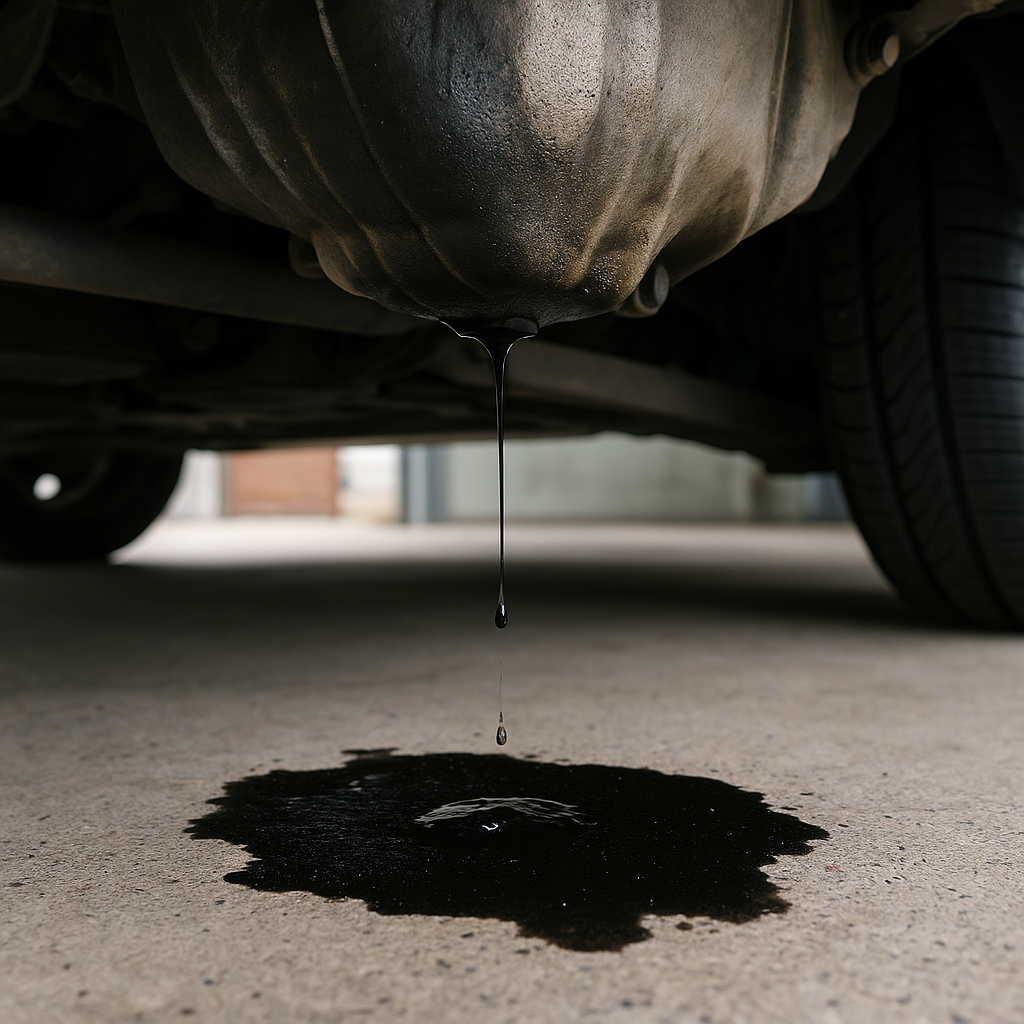
An oil leak does not automatically mean an MOT fail. A slight seep or weep may be recorded as a minor defect, but an excessive leak that creates a pool, or a continuous leak that presents a serious road-safety risk, can fail the test.
The current DVSA rules give MOT testers a clear threshold for excessive fluid leaks, so that small damp patches and serious leaks are not treated as the same thing.
THE QUICK VERDICT
Minor seep = advisory. Active drip onto the road or exhaust = fail.
More precisely, the MOT tester looks at how much fluid is escaping and the risk it creates. Under the current DVSA inspection manual, a vehicle should fail if a fluid leak creates a pool on the floor more than 75 mm in diameter within five minutes, or if several leaks together are escaping at the same rate. An excessive leak likely to harm the environment or create a safety risk is a major defect. A continuous leak likely to pose a serious road-safety risk is dangerous.
What does the MOT test check for oil leaks?
Fluid leaks are checked during the MOT with the engine idling. The tester is looking for an excessive leak and considering whether the escaping fluid could harm the environment or create a safety risk.
The important distinction is between an engine that is simply oily around a seal or gasket and one that is actively losing fluid.
The DVSA’s current MOT inspection manual, updated in June 2026, says a vehicle should fail if the leak forms a pool more than 75 mm across within five minutes. Several smaller leaks can also result in failure if, collectively, they are leaking at an equivalent rate.
An excessive leak likely to harm the environment or pose a safety risk is classed as a major defect. A fluid leak that is continuous and likely to pose a serious risk to road safety is a dangerous defect.
That is quite different from finding a bit of oily residue underneath an older engine.
When will an oil leak fail an MOT?
An excessive leak
The clearest test is the five-minute rule. If fluid leaking from the vehicle creates a pool more than 75 mm in diameter on the floor within five minutes, the DVSA says the vehicle should fail.
This is not about a single tiny drop. It is intended to distinguish a substantial active leak from minor seepage.
Several separate leaks can count too. If they collectively lose fluid at the same sort of rate, the vehicle can still fail.
A leak that creates a safety risk
Where the oil goes matters as well as how much is escaping.
Oil reaching the road can reduce grip. A leak affecting safety-critical components can be more serious still. There are also separate MOT criteria for leaks from particular systems. For example, hydraulic brake-fluid leaks can result in major or dangerous defects depending on the component and severity.
Oil reaching hot parts such as the exhaust also needs investigating promptly. Even where a leak has not yet reached the general 75 mm pooling threshold, a tester has to consider the relevant MOT defect criteria and the safety risk presented by what they find.
A continuous, seriously dangerous leak
The highest category under the general fluid-leak rules is a dangerous defect. This applies where fluid is leaking continuously and is likely to pose a serious risk to road safety.
A dangerous MOT defect should not be treated as something to drive around with until you find a convenient afternoon to fix it. The car needs repairing before it is used on the road.
When might an oil leak only get an advisory?
A minor oil seep is a different matter.
You might see a damp patch around a gasket, oily staining underneath the engine or evidence that a seal is beginning to weep. If it is not leaking excessively and does not meet the criteria for a major or dangerous defect, it need not mean an MOT failure.
A minor oil leak can instead be recorded as a minor defect or advisory.
That does not mean it should be ignored. An advisory is useful early warning. A gasket that is slightly damp this year can become a proper leak later, and regularly losing engine oil is not good news for the engine even if the car happens to pass its MOT.
Keep an eye on it rather than waiting for the driveway to tell you things have got worse.
Which fluids count under the MOT leak rules?
The general MOT fluid-leak check can cover fluids such as engine oil and other vehicle fluids where an excessive leak could harm the environment or pose a safety risk.
There are some important exceptions. The current DVSA manual specifically says leaks of engine coolant, screen wash and fluid required for Selective Catalyst Reduction, commonly known as AdBlue, are not reasons for failure under this general fluid-leak section.
That does not mean every fluid-related problem is ignored. Brake systems, steering and other components have their own MOT inspection criteria.
For example, the DVSA manual separately lists a steering box leaking oil as a minor defect, while one leaking enough for the oil to drip is a major defect. Hydraulic brake-fluid leaks can be more serious again.
So if you have found an unidentified patch underneath the car, identifying what is actually leaking matters.
Why you should deal with an oil leak even if it passes
An MOT is a minimum roadworthiness check on the day of the test. It is not a guarantee that the car will remain trouble-free for the next year.
A slow engine-oil leak can gradually lower the oil level. Run an engine with too little lubrication and wear can increase quickly, potentially turning a relatively ordinary seal or gasket repair into a much more expensive mechanical problem.
Leaks can also spread. Oil rarely respects the neat boundaries mechanics would prefer it to.
If your car has received the same oil-leak advisory for several MOTs, it is worth finding out where the oil is coming from and whether the leak is getting worse.
What to check before your MOT
You do not need a ramp or a box full of tools to spot the more obvious warning signs.
Check underneath the car
Park on a clean, dry surface and look underneath after the car has been standing. Fresh drops are more useful than an old stain that has been there since Christmas.
A clean piece of cardboard placed underneath can make new drips easier to see and can help show roughly where they are coming from.
Do not crawl underneath a vehicle unless it has been safely raised and properly supported.
Check the engine oil level
Follow the procedure in your vehicle handbook. On cars with a conventional dipstick, this normally means checking on level ground under the conditions specified by the manufacturer.
If you are repeatedly topping the oil up, do not simply assume an older car “uses a bit”. It could be burning oil, leaking it or both.
Look for fresh oil rather than old grime
Old oily residue does not necessarily tell you that there is an active leak today. Fresh, wet oil appearing around a seal, sump, filter housing or underneath the engine is more useful evidence.
Common leak sources vary considerably between vehicles, so diagnosis is better than changing parts by guesswork.
Do not try to hide a leak for the MOT
Cleaning old residue can make finding the source of a leak easier. Wiping everything down simply to disguise an active leak is another matter.
If it is leaking enough to fail, the sensible answer is to find the cause and repair it. An MOT tester is assessing the car presented to them, not awarding points for creative cleaning.
If you would rather have the leak checked before the MOT, you can book the car in with Windmill Garage at https://www.windmillgarage.co.uk/book-in-your-car/.
What happens if your car fails its MOT for an oil leak?
A leak classed as a major defect means the car has failed its MOT and the fault needs repairing.
If it is classed as dangerous, you must not drive the vehicle on the road until it has been repaired. Having time left on the previous MOT does not make a dangerous vehicle legal to drive.
There are national rules governing MOT partial retests and when they are free or charged. At Windmill Garage, the free MOT re-test applies to Class IV vehicles that fail first time.
If the car needs repairs, we will explain what we have found and what needs doing. You can see our current published prices at https://www.windmillgarage.co.uk/prices/ or call us on 02392 571003 if you would rather talk it through.
Frequently asked questions
Will a tiny oil leak automatically fail an MOT?
No. A small seep or weep does not automatically mean failure. If it is not excessive and does not create the relevant safety or environmental risk, it may be recorded as a minor defect or advisory instead.
What is the 75 mm oil leak rule?
Under the current DVSA MOT inspection manual, a vehicle should fail if a fluid leak creates a pool on the floor more than 75 mm in diameter within five minutes. Several leaks that collectively lose fluid at the same rate can also result in failure.
Why did my oil leak pass last year but get mentioned this year?
The leak may have changed. A seal that was barely damp at the previous MOT might now be actively leaking. Testers also assess the vehicle as it is presented on the day and use the DVSA inspection criteria and their judgement where those criteria require it.
If an old advisory keeps appearing, it is worth getting the source checked rather than assuming it will always remain minor.
Does a gearbox oil leak count?
Potentially, yes. The MOT includes fluid-leak checks and there are also specific criteria covering certain vehicle systems and components. What matters is the source, severity and risk created by the leak.
If you cannot tell whether a patch is engine oil, gearbox oil or something else, get it identified rather than guessing.
Can I wipe an oil leak clean before the MOT?
Cleaning old oil away can help you or a garage identify whether fresh fluid is appearing. It does not repair an active leak.
If new oil starts appearing again, find the source before the test. Much better than crossing your fingers for five minutes.
Can I drive after failing an MOT because of an oil leak?
It depends on the defect and whether your existing MOT is still valid, but the vehicle must remain roadworthy. You must not drive a vehicle with a dangerous defect on the road until it has been repaired.
If you are unsure what your failure certificate means, ask the testing garage before driving away.
Book your MOT or service in under a minute
If you have spotted an oil patch or your last MOT mentioned a leak, we can check what is actually happening and tell you what needs doing now and what can wait.
Book online any time at https://www.windmillgarage.co.uk/book-in-your-car/ or call us on 02392 571003 (Mon–Fri, 8.30am–5pm).