
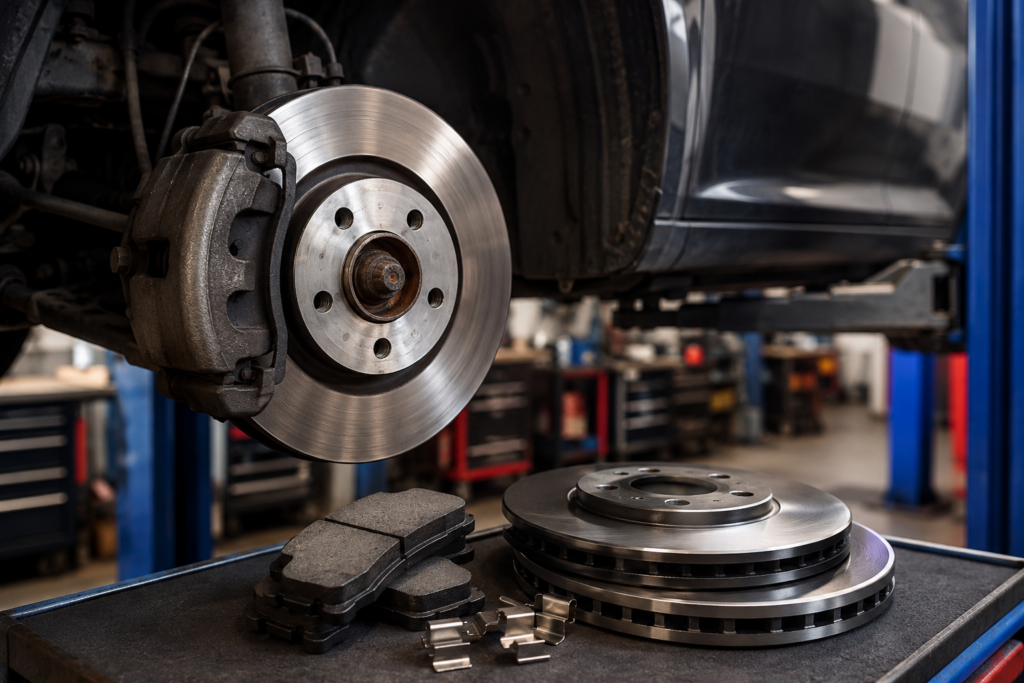
Squealing, grinding, juddering or a car that takes longer to stop are all good reasons to have your brakes checked. Sometimes it is just the pads. Sometimes the discs are worn too. The sensible answer comes from inspecting and measuring them, not guessing from the noise.
If you need brake pads or discs replaced in Horndean, we can inspect the braking system, tell you what actually needs doing and agree the price before any work starts.
Four signs your brake pads or discs need checking
Brake problems do not all announce themselves in the same way. Some make a racket. Others creep up slowly enough that you barely notice the difference.
These are four of the common signs.
1. Squealing or squeaking
A persistent squeal can come from worn brake pads, but noise alone does not prove they need replacing. Pads and discs can also squeal because of contamination, corrosion or vibration.
A brief squeak after the car has been sitting in the rain can disappear once the brakes have been used. If the noise keeps coming back, gets louder or is accompanied by a change in how the car brakes, get it checked.
Our guide to testing your brakes safely at home covers a few simple checks you can make without taking anything apart.
2. Grinding or scraping
Grinding is more serious.
If a brake pad has worn far enough, its friction material can be exhausted and metal can begin contacting the disc. Continuing to drive can damage the disc and, more importantly, leave you with braking performance you should not rely on.
Persistent grinding needs inspecting promptly. If it comes with poor braking, a pedal that feels wrong or difficulty controlling the car, do not keep driving it.
3. Judder through the pedal or steering wheel
If the pedal pulses or the steering wheel shakes when you brake, there may be a problem with the braking surfaces. Uneven disc condition or thickness can be among the causes.
It is not the only possibility, though. Tyres, steering and suspension faults can also change how a car behaves under braking, which is why diagnosis matters before parts are ordered.
If the car also knocks, wanders or feels unsettled when you are not braking, our guide to steering and suspension warning signs is worth a read.
4. The car takes longer to stop
Reduced braking performance is the one not to ignore.
If the brakes suddenly need much more pedal pressure, the pedal travels further than normal or the car simply does not stop as positively as it used to, have the braking system checked.
Pads and discs are possible causes, but so are other brake faults. Changing parts until the problem goes away is an expensive way to diagnose a car.
How worn can brake pads and discs be?
There are two different things to understand here: the manufacturer’s wear limit and the MOT rules.
They are not quite the same.
Brake pad wear limits
For an MOT, the current DVSA inspection manual says a brake lining or pad worn down to its wear indicator is a major defect. A lining or pad worn below 1.5 mm is a dangerous defect.
That does not mean 1.5 mm is a sensible target to aim for before booking the car in. The condition of the brakes and the manufacturer’s specifications matter too.
If an inspection shows that the pads are getting low, we can tell you whether they need doing now or whether there is useful life left in them.
Brake disc wear limits
There is no single minimum brake disc thickness that applies to every car.
Disc manufacturers specify a minimum thickness, often marked as “MIN TH” on the disc itself. The correct limit depends on the vehicle and brake setup, so the disc needs measuring and comparing with the right specification.
There is an important MOT distinction here too. DVSA guidance says a brake disc being below the manufacturer’s recommended limit is not, by itself, an MOT failure. For the MOT, a disc that is significantly and obviously worn is a major defect. An insecure, fractured disc or one otherwise likely to fail is dangerous.
That is why “your discs look a bit worn” is not much of a diagnosis. Measurements and condition tell the useful story.
Why brake pads and discs are replaced in axle sets
Brake components on the same axle work together.
That means the two front wheels are treated as one axle set, and the two rear wheels as another. Brake pads are replaced across the axle rather than fitting fresh pads to one wheel and leaving worn ones on the other. Brake discs should likewise be replaced as a pair.
The aim is consistent braking from the left and right sides.
If the discs need replacing, new pads are normally fitted with them. Putting partly worn pads against brand-new discs is a poor start for the new braking surfaces.
What you do not necessarily need is all four corners replacing at once. If the front brakes are worn but the rear brakes have plenty of serviceable material left, there is no virtue in changing good parts for the sake of symmetry.
We would rather tell you what needs doing now and what can wait.
How much do brake pads and discs cost to replace?
There is no honest single figure because the parts fitted to a small hatchback can cost very differently from those for a large SUV or performance car.
As a useful UK benchmark, BookMyGarage’s June 2026 booking data puts the average replacement of front brake pads and discs at about £276, with the rear averaging about £244. Checkatrade’s June 2026 figures put typical pads-and-discs replacement at roughly £189 to £276.50, depending on location and vehicle.
Those are national market figures, not Windmill Garage prices.
For Windmill Garage:
The actual price depends on the car, which axle needs attention and the parts required. We will confirm the cost before starting work, rather than putting a tempting “from” price online that bears little resemblance to the car sitting on the ramp.
You can see our currently published MOT and servicing charges on the Windmill Garage prices page. For brake repairs, contact us with your vehicle details so we can price the right parts.
Budget versus premium brake parts
There is nothing clever about fitting the cheapest brake parts available simply to make the initial bill smaller.
Different brake pads can vary in materials, noise, feel, heat performance and wear characteristics. The right choice also depends on the vehicle and the specification required by its braking system.
What matters is that the parts are suitable for the vehicle and fitted properly. Cheap parts that wear quickly, make excessive noise or give poor service are not much of a saving once you are paying to have the job done again.
If there is a sensible choice between parts, we can explain it. No mysterious upgrade package required.
How long does brake pad and disc replacement take?
There is no fixed time that applies to every car.
Access varies between vehicles, rear electronic parking brake systems can require different procedures, and an inspection may uncover a sticking calliper or another problem that caused the unusual wear in the first place.
If you are booking brake work with us, we will tell you what to expect for your particular car. We do not promise a fixed turnaround before we know what is on the ramp.
For other wear-and-tear work, see our car repairs in Horndean.
Do worn brakes always mean new pads and discs?
No.
A squeak does not automatically mean you need a complete set of brakes, just as a visible lip on a disc does not tell you its remaining thickness.
A proper inspection should look at pad thickness, disc thickness and condition, wear on both sides and whether the callipers are working correctly. If something is wearing unevenly, there is a reason for it. Finding that reason matters.
Sometimes pads are all that is needed. Sometimes pads and discs need replacing together. Occasionally the noise is pointing somewhere else entirely.
That is the value of checking first.
Brake pads and discs FAQ
Can I drive with grinding brakes?
Persistent grinding should be treated seriously. If it is accompanied by reduced braking performance, vibration, a changed pedal feel or difficulty controlling the car, stop using the vehicle and arrange an inspection without driving it.
Even where the car still appears to stop normally, grinding needs checking promptly rather than waiting to see what happens.
Do rear brakes last longer than front brakes?
Often they can, because the front brakes typically do more of the work when a car slows down. But there is no reliable mileage at which either end will wear out. Vehicle design, driving conditions, corrosion and faults such as a sticking calliper all affect brake life.
Inspection beats mileage.
Does brake fluid need changing when pads and discs are replaced?
Not automatically. Brake fluid has its own maintenance requirements, which vary by vehicle manufacturer.
Changing pads or discs does not by itself mean the brake fluid must be replaced. We would check the vehicle’s requirements and the fluid’s condition rather than adding the job simply because the wheels are already off.
Will worn brake pads fail an MOT?
They can. Under the current DVSA MOT inspection manual, a brake pad or lining worn down to its wear indicator is a major defect. If it is worn below 1.5 mm, it is classed as dangerous.
The MOT also checks brake performance and other parts of the braking system, so pad thickness is only one part of the test.
Do I need new pads whenever the discs are changed?
New brake discs should be fitted with new pads. This gives the new discs a fresh, consistent friction surface to work against. Discs are also replaced as a pair across the same axle.
Where can I get brake discs replaced near Horndean?
Windmill Garage carries out brake repairs and general car repairs at 249 London Road, Horndean, Waterlooville, Hampshire PO8 0HW. We are open Monday to Friday, 08:30–17:00, and the online diary is available 24/7.
Book your MOT or service in under a minute
If your brakes are squealing, grinding, juddering or simply do not feel as they normally do, get them checked before a worn part becomes a bigger job.
Book online any time at https://www.windmillgarage.co.uk/book-in-your-car/ or call us on 02392 571003 (Mon–Fri, 8.30am–5pm).