
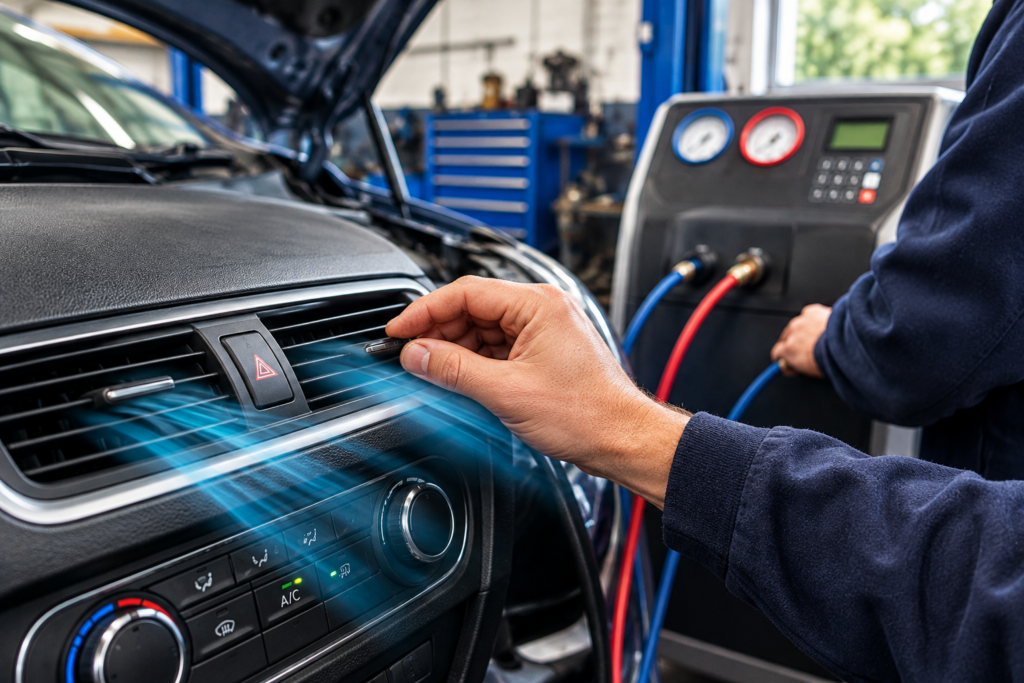
If your car air conditioning is blowing warm rather than properly cold, it may simply need a re-gas. But not every air-con problem is a gas problem, so the sensible first step is to check what the system actually needs rather than automatically filling it up again.
Windmill Garage provides car air conditioning re-gas and servicing in Horndean for local drivers. We work on nearly all makes and models, and you can book your car in online at any time.
Signs your car air conditioning needs attention
Air conditioning tends to lose performance gradually. One summer it is properly cold, the next it is merely cool, and eventually you find yourself pointing every vent at your face and hoping for the best.
A few signs are worth paying attention to.
The air is not getting properly cold
This is the obvious one. If the air from the vents stays warm, or takes much longer than it used to to cool the cabin, the system may be low on refrigerant.
Refrigerant is the substance that circulates through the air-conditioning system and allows it to move heat out of the cabin. If the level becomes too low, the system cannot do its job properly.
Warm air does not automatically mean it needs a re-gas, though. A leak, faulty compressor, electrical problem or another component fault can produce similar symptoms.
Your windows are taking longer to demist
Air conditioning is useful in Hampshire in January too.
The system removes moisture from the air, which helps clear condensation from the inside of the windows. If demisting has become noticeably slower, reduced air-con performance may be part of the problem.
There is a musty smell from the vents
A damp or musty smell deserves attention, but this is where an important distinction gets missed.
A re-gas replaces or replenishes the refrigerant needed for cooling. It does not automatically cure smells caused by bacteria, mould or contamination around the evaporator and ventilation system.
If smell is the main problem, tell us when you book. We can look at what is actually causing it rather than assuming more gas will fix it.
Air-con re-gas or air-con repair: which does your car need?
A re-gas makes sense when the air-conditioning system is otherwise working but its refrigerant level has fallen over time.
It is a different matter if the system has a fault.
For example, if your air conditioning was re-gassed recently and has already stopped cooling properly again, simply adding more refrigerant is unlikely to be a good answer. The system may have a leak that needs finding.
The compressor can cause trouble too. It is the part that circulates refrigerant around the system, and a compressor or associated electrical fault will not be cured by a re-gas.
That distinction matters because refrigerant is not a magic fix for every air-conditioning fault. We would rather establish what the car needs and tell you plainly than sell you the wrong job.
If further fault-finding or repair is needed, we will explain what we have found and agree any additional work with you first. The same approach applies across our other vehicle services: what needs doing now, what can wait, and no surprises on the invoice.
What happens during an air conditioning re-gas?
A proper re-gas is more than connecting a can and adding some refrigerant.
The existing refrigerant is recovered from the system using the appropriate equipment. The system is then vacuumed and checked before the correct amount and type of refrigerant is put back in. Oil and dye are added as required, and the air temperature is checked afterwards.
The important bit is the correct amount. Different cars have different specified refrigerant charges, so more is not better.
There are also legal controls around automotive refrigerants. Technicians recovering fluorinated refrigerant from qualifying car and van air-conditioning systems must hold the relevant qualification. This is one reason the job belongs with the proper equipment rather than a bit of guesswork on the driveway.
Why is an air-con re-gas a drop-off job?
Our online booking system treats an air-con re-gas as a drop-off job because different cars and systems take different amounts of time.
We do not promise a blanket “done in an hour” time because that would not be particularly useful if your car is the one that takes longer. Leave it with the workshop and we can carry out the process properly.
If your MOT or service is due around the same time, it is worth booking the air-con work alongside it. One visit instead of two. Nobody has ever complained about making fewer trips to a garage.
How often should you re-gas your car air conditioning?
You will often see every two years recommended for car air conditioning, including by major UK motoring organisations. It is a useful rule of thumb rather than a legal deadline.
There is no annual air-con re-gas requirement comparable with an MOT. If a system is working properly, you do not need to panic because a calendar says exactly two years have passed.
On the other hand, refrigerant can gradually escape through seals, hoses and connections over a period of years. If the cooling performance has dropped, the car has no record of an air-con service or it has been a few years since anyone looked at the system, getting it checked is sensible.
What is not normal is needing another re-gas a few weeks or months after the last one. That points towards a fault or leak worth investigating rather than repeatedly topping the system up.
Regular use can help too. Run the air conditioning throughout the year rather than leaving it switched off all winter.
What does an air-con re-gas cost at Windmill Garage?
[CONFIRM: air-con re-gas price, including whether separate prices apply to R134a and R1234yf systems]
The cost of an air-con re-gas can vary according to the refrigerant your vehicle uses, so we will not put an unconfirmed figure here.
You can see Windmill Garage’s current published charges on our prices page or call the workshop on 02392 571003 to confirm the cost for your vehicle before booking.
We agree the price before work starts. If checking the system uncovers a fault that needs further work, we will talk that through with you before going ahead.
R134a or R1234yf: which refrigerant does my car use?
Most UK cars you are likely to encounter use one of two refrigerants: R134a or R1234yf.
R134a is the older refrigerant. Because of its much higher global-warming potential, its use in the air conditioning of new cars was phased out under environmental rules. R1234yf is the lower-impact refrigerant now widely used in newer vehicles.
The change did not happen neatly on New Year’s Day of one particular model year, so age alone is not a reliable way to identify what your car takes. Some cars made during the transition period may use a different refrigerant from another car of a similar age.
The vehicle’s air-conditioning label or manufacturer information gives the correct specification. We check what the car requires rather than guessing from the number plate.
Should you use a DIY air-con top-up can?
You can find DIY air-conditioning recharge products for sale, but our advice is simple: know what you are trying to fix first.
A top-up may appear to make a low system cold again, but it cannot tell you why the refrigerant was low. It also makes it harder to know that the system contains the manufacturer’s specified quantity unless the job is being done with suitable equipment.
There is another practical point. Refrigerants are controlled substances, and UK rules restrict work with F-gases and their supply for servicing vehicle air-conditioning systems.
For most drivers, a proper check and re-gas is the better bet. You get the right refrigerant, the right quantity and a chance to spot when the problem is actually something else.
Does using air conditioning increase fuel consumption?
Yes, running the air conditioning requires energy, so in a petrol or diesel car it can increase fuel consumption to some degree.
That does not mean you should avoid using it. Air conditioning helps keep the cabin comfortable and is particularly useful for demisting windows.
There is also no universal rule that opening the windows is always cheaper. Vehicle speed and aerodynamic drag make a difference. We have covered that question separately in our guide to air conditioning versus driving with the windows open.
Car air conditioning re-gas in Horndean
Windmill Garage is a family-run MOT, servicing and repair centre at 249 London Road in Horndean. We have looked after local drivers for over thirty-five years.
If your air conditioning has stopped getting properly cold, book it in and we can establish whether a re-gas is the right job. If the problem turns out to need more than refrigerant, we will explain that before any additional work is carried out.
Frequently asked questions
How long does a car air-con re-gas take?
It depends on the vehicle and system, which is why we ask customers to leave the car with the workshop rather than promising one fixed time for every model.
How often should car air conditioning be re-gassed?
Around every two years is a commonly recommended guideline, but it is not a legal requirement. If the system is cooling properly, there is no reason to treat two years as a hard deadline. If it loses its cooling again shortly after a re-gas, have it checked for a fault.
Should I run my air conditioning in winter?
Yes. Air conditioning is useful for removing moisture and helping to demist windows, and using the system regularly throughout the year is sensible.
What is the difference between R134a and R1234yf?
They are different refrigerants used in vehicle air-conditioning systems. R134a is common in older cars, while R1234yf is widely used in newer vehicles and has a much lower global-warming potential. Your car must be filled with the refrigerant specified for its system.
Will a re-gas fix a musty smell?
Not necessarily. A smell can come from bacteria, mould or contamination in the evaporator or ventilation system. A refrigerant re-gas deals with cooling performance, so tell us if smell is the main symptom.
Does warm air mean my compressor has failed?
No. Low refrigerant is one possible cause, but leaks, compressor faults and electrical problems can all stop the system cooling. Checking before replacing parts is the sensible way round.
Book your MOT or service in under a minute
If the air-con is blowing warm, book it in and we will check whether it needs a re-gas or something more.
Book online any time at https://www.windmillgarage.co.uk/book-in-your-car/ or call us on 02392 571003 (Mon–Fri, 8.30am–5pm).