
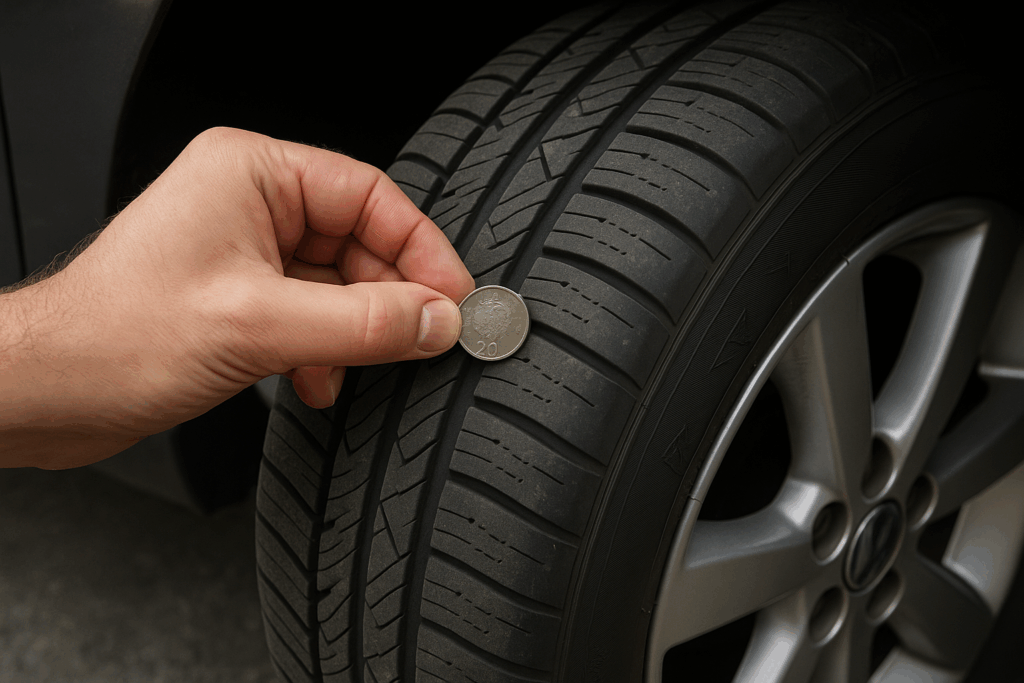
The legal tyre tread depth for cars in the UK is at least 1.6mm across the central three-quarters of the tread, around the full circumference of the tyre. If the required tread drops below 1.6mm, the tyre will fail an MOT.
That is the legal minimum, though. For wet-road performance, there is a good reason to start thinking about replacement before you get that far.
What is the legal tyre tread depth in the UK?
For most cars and light vans, the law requires the primary tread grooves to be at least 1.6mm deep across the central three-quarters of the tyre’s tread width and around its entire circumference.
That wording matters. One healthy-looking patch of tread is not enough. The required depth has to continue all the way around the tyre within that central three-quarter section.
This is also the standard used during an MOT. The current DVSA MOT inspection manual, updated in June 2026, confirms the 1.6mm requirement for the relevant passenger and light goods vehicles.
There is an important distinction between legal and in good condition, too. A tyre can have enough tread and still have a problem that makes it unsafe or causes an MOT failure. Cuts, bulges, exposed cords and other serious damage all matter.
If your MOT is coming up, our full checklist covers the other simple things worth checking before test day:
How to check tyre tread with a 20p coin
The 20p test is a useful quick check when there is no tread-depth gauge handy.
How to do the 20p tyre test
Put a 20p coin into one of the main tread grooves and look at the outer band around the edge of the coin.
If that outer band disappears into the groove, you have a reasonable amount of tread at that point. If you can clearly see the outer band, the tyre is getting worn and should be checked properly.
Do not test one spot and call it done. Check several positions around each tyre and across the main grooves within the central part of the tread. Tyres do not always wear evenly.
And one useful correction to a lot of online advice: the 20p test is a rough warning check, not a precise measurement of the legal 1.6mm limit. If the tread looks close, use a proper tread-depth gauge or have the tyre measured. A coin is handy. It is not calibrated workshop equipment.
When does tyre tread cause an MOT failure?
An MOT tester assesses whether the tyre meets the required tread-depth standard. For the usual passenger car, the primary grooves need at least 1.6mm within the central three-quarters of the tread width, continuously around the tyre.
If the tread does not meet that requirement, it is an MOT failure.
Tyres are checked for more than tread depth, however. An MOT can also identify faults involving tyre condition, suitability or fitment. That includes serious cuts or damage, lumps and bulges, exposed cords and certain incorrect tyre combinations.
So a successful 20p check is not an MOT pass in your pocket. It tells you something useful about tread. It does not inspect the rest of the tyre.
If anything looks doubtful, particularly a bulge or exposed cord, get it checked rather than waiting for the MOT to make the decision for you.
Why consider changing tyres at 3mm if 1.6mm is legal?
This is where legal minimums and sensible maintenance part company.
A deeper tread is better able to clear water from underneath the tyre. As the grooves become shallower, their ability to move that water reduces, which can affect wet braking and increase the risk of aquaplaning.
Research carried out by MIRA and widely cited in UK tyre-safety guidance found a substantial difference in wet braking performance between tyres at 3mm and those worn to 1.6mm. Testing reported that 3mm tread could provide around 25% better wet braking performance than 1.6mm, representing roughly 8 metres of additional braking distance in the test conditions.
Other controlled tyre testing shows the same basic pattern: wet performance deteriorates as tread wears. Continental, for example, reports testing in which tyres at the 1.6mm legal minimum took 6.9 metres further to stop than tyres with 8mm tread, while tyres at 3mm took 2.7 metres further.
Those numbers should not be treated as a fixed stopping-distance formula for every car. Tyre design, road surface, weather, speed, temperature, vehicle condition and plenty else affect the result. What the testing does show clearly is why waiting for the last fraction of legal tread is not always the best approach, particularly on wet Hampshire roads.
So if we tell you a tyre at around 3mm is worth keeping an eye on, that does not mean 3mm is the legal limit. It isn’t. It means there is less useful wet-weather tread left than there was, and replacement can sensibly be planned rather than left until the tyre reaches 1.6mm.
A tread gauge gives you a better answer
For a proper measurement at home, a tyre tread-depth gauge is better than a coin.
Measure the main tread grooves in several places across the relevant part of the tyre and at several points around its circumference. You’re looking for the lowest readings, not simply the nicest one.
Uneven readings can tell you something as well. If one part of a tyre is wearing noticeably faster than another, there may be an issue with pressure, wheel alignment or another part of the car that deserves checking.
The same applies if one tyre is wearing much faster than its opposite number. Replacing the rubber deals with the worn tyre, but it is worth understanding why it wore that way in the first place.
Check more than the tread
Tread depth is easy to measure, which means it tends to get all the attention. Give the rest of each tyre a look while you’re there.
Check for:
- cuts, cracks or other visible damage
- lumps or bulges in the sidewall
- exposed cords or ply
- objects embedded in the tyre
- noticeably uneven tread wear
- obviously low tyre pressure
Check the pressure against the vehicle manufacturer’s figure as well. You’ll normally find that in the handbook or on a label fitted to the car.
If you find a bulge, exposed cords or significant damage, do not rely on the fact that the tread still measures above 1.6mm. Tread is only one part of a tyre’s condition.
How often should you check tyre tread?
A quick look at the tyres should be part of normal car maintenance, rather than something reserved for the night before an MOT.
It is particularly worth checking before a long journey and when you know the tread is getting lower. If you are approaching 3mm, measuring it occasionally with a gauge gives you a much clearer idea of how quickly the tyre is wearing.
Also check after hitting a substantial pothole or kerb if you notice a change in the car afterwards. Hampshire roads do occasionally provide their own suspension testing programme.
Tyre tread depth FAQ
Is 2mm tyre tread legal in the UK?
For a normal passenger car, 2mm is above the 1.6mm legal tread-depth minimum, provided the required depth is present across the central three-quarters of the tread and around the full circumference. It is close to the limit, though, so replacement is something to plan rather than forget about.
Will 1.6mm tyre tread pass an MOT?
The required tread must be at least 1.6mm, so tread at the minimum can meet the tread-depth requirement if it is present in the required area around the whole circumference. The tyre must also satisfy the MOT requirements for its general condition and suitability.
Is 3mm the legal tyre tread limit?
No. For the usual car or light van, the legal minimum is 1.6mm in the required part of the tread. Around 3mm is commonly used as a point to consider replacement because wet braking and water-clearing performance reduce as tread wears.
Is the 20p test accurate?
It is useful as a quick check, but it is not a substitute for an accurate tread-depth measurement. If a tyre looks worn or the result is borderline, use a proper gauge or ask a garage to measure it.
Can a tyre fail an MOT even with enough tread?
Yes. Tread depth is only part of the MOT tyre inspection. Serious damage, exposed cords, lumps, bulges and other tyre defects can also result in a failure.
Not sure how much tread is left?
If you’ve measured the tyres twice and are still squinting at the ruler, bring the car to us.
Windmill Garage is a family-run MOT, servicing and repair centre at 249 London Road, Horndean, Waterlooville, Hampshire PO8 0HW. We’ve been looking after local drivers for over thirty-five years, and we can check your tyres and fit replacements where needed.
We will tell you what needs doing now and what can wait. If you want to check current garage prices, they are published here:
For anything you want to ask before booking:
Heading 2: Book your MOT or service in under a minute
If your tread is getting low, we can check the tyres properly and arrange fitting where replacement is needed.
Book online any time at https://www.windmillgarage.co.uk/book-in-your-car/ or call us on 02392 571003 (Mon–Fri, 8.30am–5pm).