
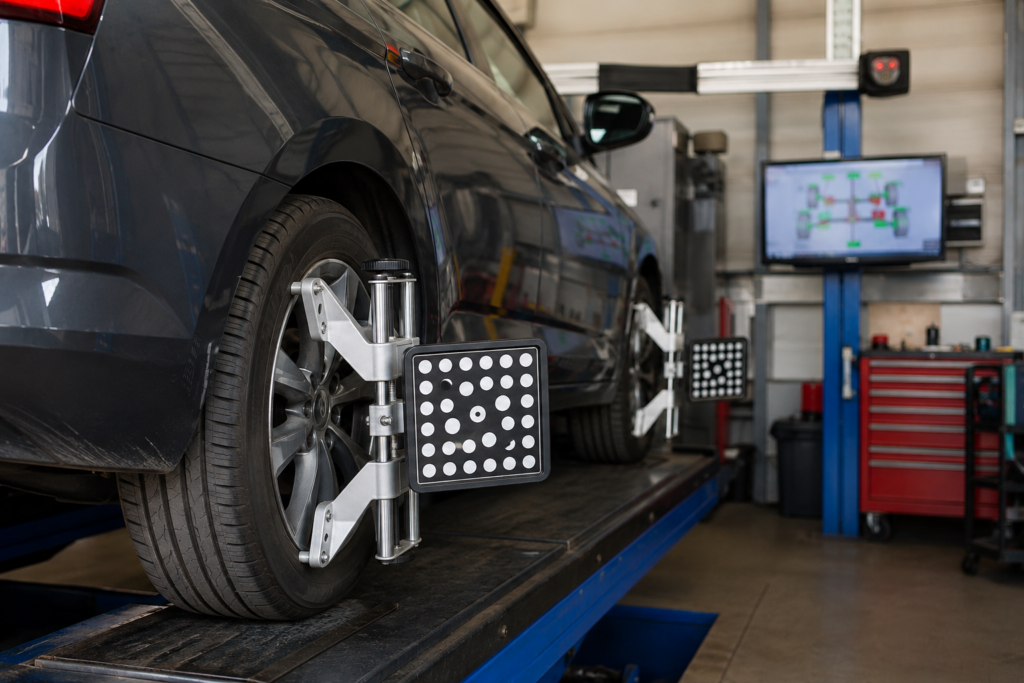
If your car pulls to one side, the steering wheel sits crooked when you are driving straight, or one edge of a tyre is disappearing faster than the rest, the wheel alignment is worth checking. Sometimes the cause is as simple as incorrect tyre pressures. Sometimes a pothole, kerb strike or worn suspension part has knocked the geometry out.
For drivers around Horndean, Clanfield and the surrounding Hampshire roads, none of those situations is particularly unusual. Potholes are not kind to wheels and suspension, however carefully you try to miss them.
What is wheel alignment and tracking?
Wheel alignment is about the angles at which your wheels sit and point relative to the car and the road. The aim is to have them set correctly for the vehicle, so the tyres run as the manufacturer intended rather than scrubbing their way along the tarmac.
You will also hear the word “tracking”. Traditionally, tracking refers mainly to adjusting the toe of the front wheels. Wheel alignment can be a broader term covering the geometry of the vehicle and, depending on the car, more than one angle or axle.
The important bit for the driver is simpler: if the wheels are not pointing where they should, the car may not drive properly and the tyres can wear unevenly.
Pulling to one side: alignment or tyre pressures?
A car that wants to wander left or right is one of the best-known signs of an alignment problem, but don’t assume tracking is automatically the answer.
Start with the tyres.
Check the pressures when the tyres are cold and set them to the vehicle manufacturer’s figures. Those figures are normally in the handbook or on a label inside the driver’s door area or fuel flap, depending on the car. Incorrect or uneven pressures can affect steering and handling.
The Highway Code also warns that under-inflated or over-inflated tyres can adversely affect steering. Excessive or uneven tyre wear can have several causes, including suspension or braking faults as well as wheels being out of alignment.
If the pressures are correct and the car still pulls noticeably on a reasonably level road, get it checked. Other clues include:
- a steering wheel that is off-centre while travelling straight
- uneven or unusually quick tyre wear
- steering that feels different after hitting a pothole or kerb
- a change in handling after steering or suspension work
Road camber can make a car drift slightly, so one stretch of road is not much of a diagnosis. If the behaviour is consistent, that is more useful evidence.
Your tyres can tell you quite a lot
One of the clearest signs of poor alignment is uneven tread wear.
[IMAGE: inner-edge wear on a misaligned tyre, showing the worn shoulder beside healthier tread across the rest of the tyre]
If one shoulder of a tyre is wearing much faster than the rest, alignment is one possible cause. The awkward part is that the inner edge is also the bit many drivers rarely see.
Have a look across the full width of each tyre rather than checking the outside edge alone. Run your eyes over both shoulders and the centre of the tread. If you can safely see the inner edge, check that too.
Uneven wear does not prove the alignment is wrong. Worn suspension components, tyre pressures and other faults can produce odd wear patterns as well. That is why finding the cause matters more than simply adjusting something and sending the car away.
There is a legal reason to keep an eye on it too. For cars and light vans, the minimum tread depth is 1.6 mm across the central three-quarters of the tyre, around its entire circumference.
Our guide to tyre tread depth and the legal limit explains how to check yours at home.
What actually gets adjusted?
Alignment terminology can sound rather more complicated than the job needs to from the driver’s side. Two terms are particularly useful to know.
Toe, or tracking
Imagine looking down at the car from above.
If the fronts of a pair of wheels point slightly towards each other, that is toe-in. If they point away from each other, that is toe-out.
Cars are designed with specific geometry settings rather than every wheel simply being made visually dead straight. Alignment equipment allows those angles to be measured against the correct specification.
On many cars, toe is the adjustment people mean when they ask for “tracking”.
Camber
Now imagine looking at a wheel from directly in front of the car.
Camber describes how much the top of the wheel leans inward or outward. Again, the correct figure depends on the vehicle.
Not every alignment angle is adjustable on every car. If a measurement is outside specification and there is no normal adjustment available, that can point towards worn, bent or damaged components rather than something that should simply be wound back into place.
That distinction matters. An alignment machine can measure a problem, but it cannot make a bent suspension component unbent. Machines have their limits.
Should I get the alignment checked after hitting a pothole?
Not after every tiny bump. You would spend most of your life at a garage.
After a hard pothole impact or kerb strike, though, pay attention to how the car feels. It is sensible to arrange an inspection if:
- the steering wheel is suddenly off-centre
- the car starts pulling to one side
- you notice a vibration or a new noise
- a tyre or wheel is visibly damaged
- tyre wear starts becoming uneven
- the steering or handling simply feels different
A heavy impact can affect more than alignment. Wheels, tyres, steering and suspension components can all take the force, which is why adjusting the tracking without looking for damage first is not always the right answer.
We have covered that in more detail in our guide to how poor road conditions can affect your vehicle.
That is particularly relevant around Hampshire’s smaller roads. Repeated potholes, rough edges and the occasional unavoidable thump can make alignment something worth checking more than once in a car’s life.
How much does wheel alignment cost?
[CONFIRM: Windmill Garage wheel alignment/tracking price and whether pricing differs for front tracking, four-wheel alignment or vehicle type.]
We publish our confirmed MOT and servicing charges on our prices page, but we would rather leave an alignment price blank here than give you a figure that may not apply to your car.
The cost can depend on what needs measuring and adjusting, the vehicle’s suspension design and whether anything is seized, worn or damaged.
The same applies to the time involved.
[CONFIRM: typical Windmill Garage wheel alignment/tracking appointment time, if the garage wants to publish one.]
If an adjustment will not move because a component is seized, or the readings suggest another fault, that needs dealing with properly rather than forcing an arbitrary promise about how quickly the job will be finished.
Call us on 02392 571003 with your registration and we can tell you what applies to your car.
Wheel alignment vs wheel balancing
These get mixed up all the time. They are different jobs.
Wheel alignment or tracking concerns the direction and angles of the wheels.
Wheel balancing concerns the distribution of weight around a wheel and tyre assembly. Small balancing weights are used to correct an imbalance.
An alignment problem is more likely to show itself through pulling, an off-centre steering wheel or uneven tyre wear. A wheel-balancing problem commonly shows itself as vibration, often becoming more noticeable at particular road speeds.
There can be overlap in what a driver feels, and damaged tyres, wheels or suspension can muddy the picture further. If you are not sure which one you need, describe the symptom rather than trying to diagnose it yourself.
We can deal with tyres and a range of related jobs too. You can see our other vehicle services in Horndean for more details.
Is wheel alignment part of the MOT?
For an ordinary Class IV car, wheel alignment or tracking is not a standalone MOT measurement in the way tyre tread depth is. The MOT does, however, inspect relevant steering, suspension, wheels and tyres, and defects in those areas can result in a failure.
An MOT certificate is not a guarantee that the car will remain roadworthy afterwards either. GOV.UK is clear that the driver remains responsible for making sure a vehicle is safe to drive.
So if the car has started pulling or chewing through the edge of a tyre, there is little sense waiting for the next MOT to investigate it.
Wheel alignment in Horndean and near Clanfield
Windmill Garage is at 249 London Road, Horndean, Waterlooville, Hampshire PO8 0HW, handy for drivers coming from Horndean, Clanfield and the surrounding area.
We are a family-run MOT, servicing and repair garage and have looked after local cars for more than thirty-five years. The approach with alignment is the same as everything else in the workshop: find out what is actually wrong, explain it plainly and agree any work before it is done.
If the tracking simply needs correcting, that is the job. If the tyre pressures are wrong or there is a worn suspension component that needs attention first, we will tell you that instead.
No point adjusting around the real problem.
FAQ
How do I know if my wheel alignment is wrong?
Common signs include uneven tyre wear, a steering wheel that sits off-centre and a car that consistently pulls to one side. Check your tyre pressures first, because incorrect pressures can cause handling problems too.
Is tracking the same as wheel alignment?
The terms are often used interchangeably, but tracking usually refers specifically to toe adjustment. A fuller wheel-alignment check can measure several aspects of the vehicle’s geometry.
Should I get my tracking checked after hitting a pothole?
A small bump does not automatically mean you need alignment. After a hard impact, get the car checked if the steering changes, it starts pulling, you see tyre or wheel damage, or you notice unusual vibration or tyre wear.
Can bad wheel alignment ruin tyres?
It can cause uneven or accelerated tyre wear. Catching the problem earlier may prevent a usable tyre from wearing badly on one edge while plenty of tread remains elsewhere.
Does wheel alignment fix steering-wheel vibration?
Not necessarily. Vibration can be caused by wheel imbalance, tyre or wheel damage and other mechanical problems. Alignment and balancing are different jobs, so the cause should be checked rather than guessed.
How often should wheel alignment be done?
There is no single interval that suits every car and every driver. It is worth checking when symptoms appear, after a significant pothole or kerb impact, after relevant steering or suspension work, or if your tyres show unexplained uneven wear.
Book your MOT or service in under a minute
If your car is pulling, wearing a tyre unevenly or has taken a proper thump from a Hampshire pothole, get it checked before a small problem eats its way through a good tyre.
Book online any time at https://www.windmillgarage.co.uk/book-in-your-car/ or call us on 02392 571003 (Mon–Fri, 8.30am–5pm).