
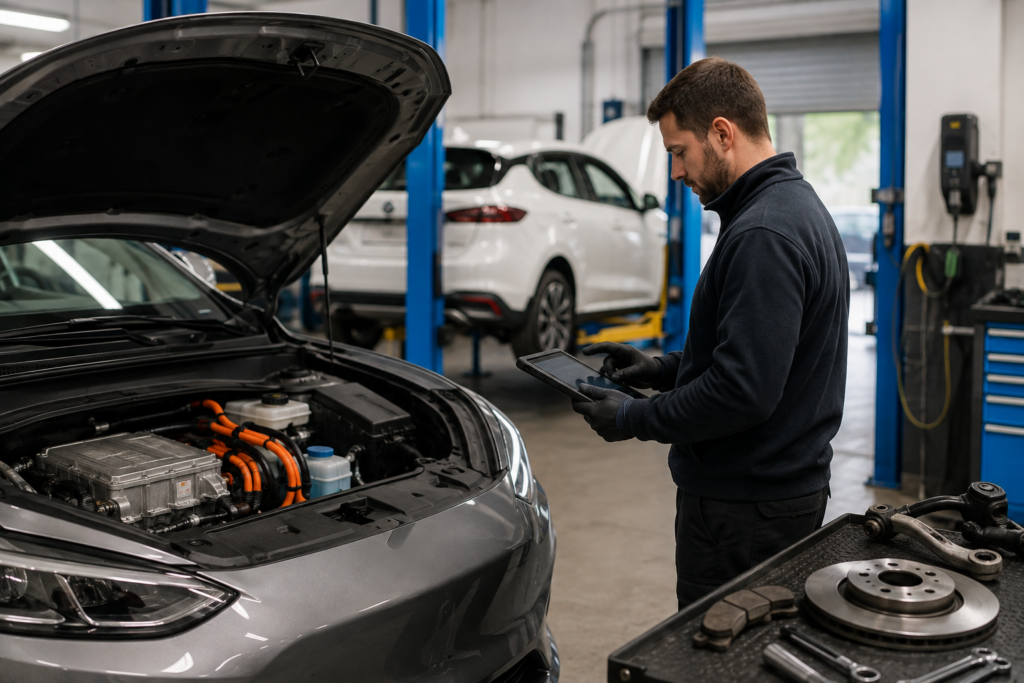
Yes. Electric and hybrid cars still need servicing, but what needs doing is different from a conventional petrol or diesel car.
A fully electric car generally needs less routine maintenance because there is no combustion engine, engine oil, spark plugs or cambelt to worry about. A hybrid still has a petrol or diesel engine as well as its electric system, so it retains many of the familiar service items.
The important bit is not to mistake “less servicing” for “no servicing”. EVs still have brakes, tyres, suspension, steering, fluids, filters and plenty of other components that need looking after.
What does an electric car service actually include?
An electric vehicle has fewer moving parts in its powertrain than a petrol or diesel car, so an EV service can be quite different.
Exactly what needs checking depends on the make, model, age and mileage. The manufacturer’s service schedule should always be the starting point rather than applying a generic service interval to every electric car.
Typical items that may need checking include:
- tyres and tyre pressures
- brake pads, discs and braking components
- brake fluid
- steering and suspension
- wheel bearings
- lights
- wipers and washers
- cabin or pollen filter
- 12-volt battery
- cooling systems and coolant where applicable
- charging equipment and visible cables
- warning lights and diagnostic systems
- air conditioning
- manufacturer-specified fluids and service items
Some manufacturers also specify inspections of high-voltage components or particular coolant and transmission fluids at set intervals.
That is why an EV service should be based on the schedule for the actual car rather than somebody simply saying, “It’s electric, so there’s nothing to service.”
If you are looking for local car servicing, you can read more about servicing at Windmill Garage.
What doesn’t an electric car need?
This is where EV ownership becomes simpler.
A battery-electric vehicle does not have a conventional petrol or diesel engine, so it does not need many of the routine jobs associated with one.
That normally means no:
- engine oil changes
- engine oil filter changes
- spark plug replacements
- diesel fuel filters
- conventional cambelt changes
- exhaust system maintenance
There are fewer mechanical parts doing the hard work, which can mean fewer routine service items.
But don’t assume that every fluid disappears just because the engine has. Depending on the vehicle, an EV may still use coolant for its battery, motor or power electronics, brake fluid and transmission or reduction-gear lubricant.
Service requirements vary considerably between manufacturers, so check the handbook or manufacturer’s current schedule for your particular car.
EV tyres can have a hard life
Tyres are one area EV owners should pay particular attention to.
Electric cars are often heavier than comparable petrol cars because of the battery pack. Electric motors can also deliver a lot of torque immediately. Put the two together and tyres can work hard, particularly if the car is driven enthusiastically.
That doesn’t mean every electric car automatically eats through tyres. Driving style, wheel alignment, tyre choice, road conditions and tyre pressures all make a difference.
It does mean you shouldn’t overlook them just because the rest of the car requires less routine maintenance.
Check the tread across the full width of each tyre rather than just looking at the outside edge. Uneven wear can point towards an alignment or suspension problem, while incorrect pressures can increase wear and affect efficiency.
EV brakes may wear more slowly, but they still need checking
Here’s one of the slightly odd things about maintaining an electric car: using the brakes less can create its own problems.
EVs use regenerative braking. When you slow down, the electric motor can help reduce the car’s speed while putting some energy back into the battery. As a result, the conventional friction brakes may be used less than they would be on a petrol or diesel car.
That can mean brake pads and discs last longer.
But longer-lasting does not mean maintenance-free.
Brake discs can corrode when they aren’t being used heavily, while callipers and other components still need to operate correctly. Brake fluid also remains a service item according to the manufacturer’s schedule.
So don’t judge the condition of an EV’s brakes purely by how much material is left on the pads. Their overall condition matters too.
What about hybrid cars?
Hybrids need servicing too, and in some ways there is more to consider because you have two types of propulsion system in one vehicle.
There are several types of hybrid, including mild hybrids, full or self-charging hybrids and plug-in hybrids. The systems work differently, but they all combine an internal combustion engine with some form of electrical assistance. Plug-in hybrids can additionally charge their battery from an external electricity supply.
You can read our guide to hybrid cars for families if you’re deciding whether one would suit you.
Hybrids still have an engine to service
Unlike a fully electric car, most hybrids retain familiar engine service items.
Depending on the manufacturer’s schedule, these can include:
- engine oil and oil filter
- engine air filter
- spark plugs on petrol hybrids
- engine coolant
- other engine and transmission fluids
- belts and other model-specific components
You then have the electrical and hybrid systems alongside them.
A common mistake is to think that a plug-in hybrid which spends much of its time running electrically doesn’t need its engine serviced as often. Don’t make that assumption. Follow the manufacturer’s specified time and mileage intervals.
Even if the petrol engine has covered relatively little mileage, oil and other components can still deteriorate with age.
Do electric cars and hybrids need an MOT?
Yes, once they reach the age at which an MOT is required.
An electric car goes through the same basic Class IV MOT roadworthiness test as other cars. The DVSA inspection covers areas including brakes, steering, visibility, lights, tyres, suspension, body structure, seat belts and other safety equipment.
The big difference is emissions.
A fully electric car has no exhaust emissions to test. Under the current DVSA MOT inspection manual, hybrid vehicles, including mild hybrids, are also excluded from the MOT exhaust emissions test.
So a hybrid having a combustion engine does not currently mean it receives the standard petrol or diesel emissions test during its MOT.
The rest of the relevant MOT checks still apply.
It is also worth knowing what an MOT isn’t. An MOT is a minimum roadworthiness test on the day it is carried out. It isn’t a substitute for servicing and it isn’t currently a comprehensive health check of an EV’s high-voltage traction battery.
At Windmill Garage, a Class IV MOT is £54.85 and includes a free re-test if the vehicle fails first time.
Does an EV need servicing every year?
Not necessarily.
There isn’t one universal servicing interval covering every electric vehicle. Manufacturers set their own requirements, which can be based on time, mileage or both.
Some EVs have relatively long service intervals, while individual items such as brake fluid or cabin filters may have their own replacement schedules.
The sensible approach is simple: follow the service schedule for your make and model.
This can be particularly important while the car is under warranty. Keep invoices and service records and make sure any work required by the manufacturer’s schedule is carried out correctly.
If you’re thinking about buying an EV rather than already owning one, our guide to electric family cars and what you need to know covers some of the practical considerations.
Can an independent garage service an electric or hybrid car?
Some EV and hybrid servicing and repair work can be carried out by appropriately equipped and trained independent garages. Other jobs require specific high-voltage training, manufacturer information or specialist equipment.
There is an important distinction here.
Replacing tyres or checking conventional suspension components is very different from opening or repairing a high-voltage traction battery.
That distinction matters because high-voltage EV and hybrid systems can present a serious risk if they are worked on without the correct knowledge and procedures.
If you’re unsure whether we can take on a particular job, call us on 02392 571003 with the make, model and registration. We can tell you before you make the journey.
When should you still use the main dealer?
There are times when the main dealer may be the sensible or necessary choice.
The obvious example is a fault with the high-voltage battery that needs investigating or repairing under the manufacturer’s warranty. If the manufacturer is paying for warranty work, you will normally need to follow its warranty process and use an authorised repairer where required.
Manufacturer recalls, certain software campaigns and some model-specific high-voltage repairs may also need dealer involvement.
That doesn’t mean an EV has to return to the dealer for every tyre, brake, suspension or routine maintenance job for the rest of its life.
The useful question is not simply “dealer or independent garage?” It is “who is properly equipped and qualified for this particular job?”
A good independent garage should be equally comfortable telling you when a job is outside its scope.
Electric cars need less maintenance, not no maintenance
The attraction of an electric car is partly its mechanical simplicity. Take away the combustion engine and you remove a long list of components that traditionally need servicing, replacing or repairing.
But underneath, it is still a car.
Its tyres still wear. Its suspension still takes the knocks from potholes. Its brakes still need to work properly. Its brake fluid ages. Its wipers wear out. Its air conditioning and cooling systems need attention. Wheel bearings, bushes, lights and electrical components can still develop faults.
A regular inspection is therefore worthwhile even when there isn’t a long list of parts to replace.
The same principle applies to hybrids, except that they retain a combustion engine and therefore need the appropriate engine maintenance as well.
FAQs about electric and hybrid car servicing
Do electric cars need oil changes?
Fully electric cars do not need engine oil changes because they don’t have an internal combustion engine. Some EVs do have lubricants or other fluids elsewhere in the drivetrain, so always follow the manufacturer’s schedule.
Do electric cars need an MOT?
Yes. The normal MOT age and frequency rules apply to electric cars. The vehicle is tested for roadworthiness, but there is no exhaust emissions test because a fully electric vehicle has no tailpipe emissions.
Do hybrid cars need oil changes?
Most hybrids have a petrol or diesel engine, so they still require engine oil and filter changes at the intervals specified by the manufacturer.
Are electric cars cheaper to service?
They can be, because there are fewer routine service parts. But the actual cost depends on the make, model, age, service schedule and any repairs required. We wouldn’t promise that every EV service will always be cheaper.
Do EV brakes last longer?
They often can because regenerative braking reduces reliance on the conventional friction brakes. However, discs, pads and callipers still need inspecting, particularly because corrosion or lack of use can cause problems.
Can Windmill Garage service my electric or hybrid car?
Call us on 02392 571003 with your registration and what the car needs, and we’ll tell you whether it’s work we can take on.
Book your MOT or service in under a minute
If your electric or hybrid car is due an MOT or service, tell us what you’ve got and we’ll make sure it’s the right job for the car.
Book online any time at https://www.windmillgarage.co.uk/book-in-your-car/ or call us on 02392 571003 (Mon–Fri, 8.30am–5pm).