
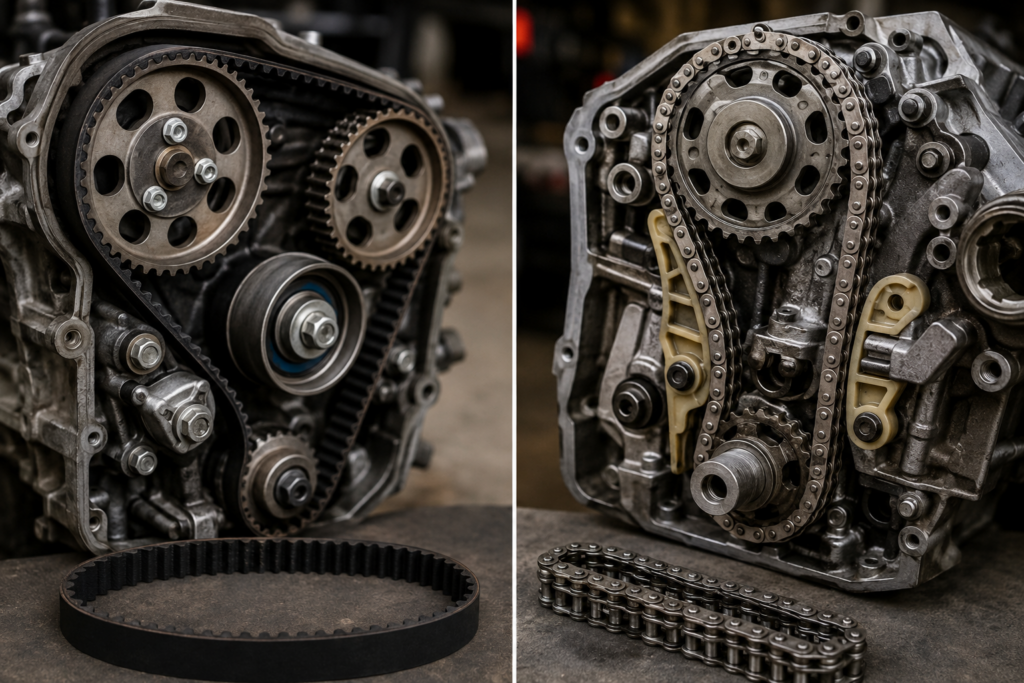
Your car’s timing system is one of the most important parts of the engine. Whether your vehicle uses a timing chain or a timing belt, its job is to keep the crankshaft and camshaft perfectly synchronised so the engine’s valves open and close at exactly the right moment.
If that timing goes wrong, serious engine damage can follow.
Many drivers know they have either a timing belt or timing chain, but few understand the differences between them or which one is more likely to fail first. The answer matters because replacing a worn timing component early is far cheaper than rebuilding an engine after a failure.
So, what usually fails first: the timing chain or the timing belt?
What Does a Timing System Actually Do?
Inside your engine, pistons move up and down while valves open and close thousands of times every minute. The timing system ensures these components move together without colliding.
If the timing slips or fails completely, the pistons and valves can strike each other. In many modern engines, this causes severe internal damage almost instantly.
Both timing belts and timing chains perform the same function, but they are built differently and fail in different ways.
What Is a Timing Belt?
A timing belt is made from reinforced rubber with strong internal fibres. It usually sits outside the engine lubrication system behind protective covers.
Timing belts became popular because they are:
- Quiet
- Lightweight
- Cheaper to manufacture
- Smooth running
However, rubber naturally deteriorates over time due to:
- Heat
- Age
- Oil contamination
- Repeated stress
- High mileage
Unlike many other engine components, timing belts are considered service items. Manufacturers normally specify replacement intervals based on mileage or age, commonly between 60,000 and 100,000 miles.
A worn timing belt may suffer:
- Cracking
- Fraying
- Tooth wear
- Delamination
- Complete snapping
The difficulty is that timing belts often fail with little warning.
What Is a Timing Chain?
A timing chain is a metal chain similar in appearance to a bicycle chain, although far stronger. It operates inside the engine and relies on engine oil for lubrication.
Timing chains are generally considered more durable than timing belts and are often described as “lifetime” components. In many cars, they can last well over 100,000 miles if properly maintained.
Timing chains are commonly found in:
- Higher performance engines
- Larger engines
- Many modern vehicles
Although chains themselves are strong, the surrounding components can wear out over time. These include:
- Tensioners
- Plastic chain guides
- Sprockets
- Oil-fed components
Poor oil maintenance is one of the biggest causes of timing chain problems. Dirty or low oil reduces lubrication and accelerates wear throughout the timing system.
What Usually Fails First?
In most cases, timing belts fail before timing chains.
The main reason is simple: rubber degrades faster than metal.
A timing belt has a predictable lifespan and will eventually wear out through normal use and ageing. This is why manufacturers specify replacement intervals. Ignoring those intervals dramatically increases the risk of sudden failure.
Timing chains usually last longer, but that does not mean they are maintenance-free. Modern timing chain systems can still develop problems, particularly when oil changes are neglected.
Interestingly, many timing chain failures are not caused by the chain itself snapping. Instead, the issue often starts with:
- Worn chain guides
- Weak tensioners
- Oil pressure problems
- Chain stretch
As the chain stretches or loses tension, engine timing becomes inaccurate. This can trigger warning lights, rattling noises and rough running before major damage occurs.
So while timing belts tend to fail earlier overall, timing chains can still become extremely expensive problems if warning signs are ignored.
Signs Your Timing Belt May Be Failing
Timing belts do not always provide obvious symptoms before failure, but there are several warning signs drivers should watch for.
Ticking Noise from the Engine
A worn timing belt can create a ticking sound from the engine bay, particularly at idle.
Engine Misfires
If the timing belt slips slightly, valve timing may become inaccurate, causing misfires or hesitation.
Rough Idling
An ageing belt can affect engine smoothness and create uneven idling.
Difficulty Starting
Incorrect timing caused by belt wear may make the engine harder to start.
Visible Cracks or Wear
During servicing, mechanics may spot cracking, fraying or worn teeth on the belt.
Replacement Interval Due
Even without symptoms, reaching the manufacturer’s replacement interval is itself a warning sign.
Signs Your Timing Chain May Be Failing
Timing chains usually provide more warning before complete failure.
Rattling Noise on Startup
One of the most common symptoms is a rattling sound from the front of the engine, especially during cold starts.
Check Engine Light
Modern engines can detect timing irregularities and trigger warning lights.
Poor Performance
A stretched chain can affect ignition timing, reducing power and efficiency.
Rough Running or Misfires
Incorrect valve timing can lead to rough idling and engine hesitation.
Metal Debris in Engine Oil
Worn timing components can release small metal particles into the oil.
Persistent Engine Noise
A loose chain or worn guides may create ongoing rattling or clattering noises.
What Happens If the Timing System Fails?
Timing system failure can be catastrophic, especially in interference engines.
In an interference engine, the pistons and valves occupy the same space at different times. If the timing system fails, they collide violently.
Potential damage includes:
- Bent valves
- Damaged pistons
- Broken cylinder heads
- Damaged camshafts
- Complete engine failure
Repair costs can quickly run into thousands of pounds. In some cases, replacing the engine becomes more economical than repairing it.
This is why preventative maintenance matters so much.
Replacing a timing belt on schedule may feel expensive, but it is far cheaper than dealing with a destroyed engine.
Timing Chain vs Belt: Which Is Better?
There is no universal winner because both systems have strengths and weaknesses.
Timing Belt Advantages
- Quieter operation
- Lower replacement cost
- Lighter weight
- Simpler design
Timing Belt Disadvantages
- Requires scheduled replacement
- Higher risk of sudden failure
- Rubber deteriorates with age
Timing Chain Advantages
- Longer lifespan
- Stronger construction
- Better durability under high stress
Timing Chain Disadvantages
- More expensive repairs
- Sensitive to oil neglect
- Can become noisy over time
- Tensioner and guide failures can still occur
For many drivers, the best system is simply the one that is maintained properly.
Timing Belts Generally Fail First, But Chains Are Not Indestructible
Timing belts generally fail before timing chains because rubber naturally wears out faster than metal. That is why timing belts require scheduled replacement throughout a vehicle’s life.
Timing chains usually last longer, but they are not indestructible. Poor oil maintenance, worn tensioners and chain stretch can all lead to expensive failures if ignored.
Whether your car uses a belt or a chain, paying attention to warning signs and following the manufacturer’s service schedule is essential.
If you are buying a used car, always check the service history carefully and find out whether the vehicle uses a timing belt or timing chain. A small amount of preventative maintenance today could save you from a major engine repair tomorrow.