
Few things ruin your day quite like an MOT emissions failure.
You book the test thinking everything is fine, only to be told your car is producing enough fumes to upset half the neighbourhood. Naturally, many drivers start searching for a quick fix, and fuel system cleaners are usually near the top of the list.
But do they actually work?
The short answer is yes, sometimes. A fuel system cleaner can help reduce emissions in certain situations, particularly if the problem is caused by carbon build-up or dirty injectors. What it will not do is magically repair a broken catalytic converter or fix a serious engine fault.
In other words, it is helpful maintenance, not wizardry in a bottle.
What Causes High MOT Emissions?
Modern engines are designed to burn fuel as cleanly and efficiently as possible. Over time though, parts get dirty, sensors wear out, and combustion becomes less efficient.
That is when emissions start creeping up.
Some of the most common causes of MOT emissions failures include:
- Dirty fuel injectors
- Carbon deposits inside the engine
- Faulty oxygen sensors
- Worn spark plugs
- Blocked diesel particulate filters
- Poor servicing history
- A failing catalytic converter
- Constant short journeys
Short trips are a surprisingly common culprit. If your car rarely gets properly warmed up, soot and carbon deposits can build up much faster. Diesel cars especially dislike endless school runs and supermarket hops.
You can think of it a bit like only ever walking your dog to the end of the driveway. Eventually things are going to get unhealthy.
What Does a Fuel System Cleaner Actually Do?
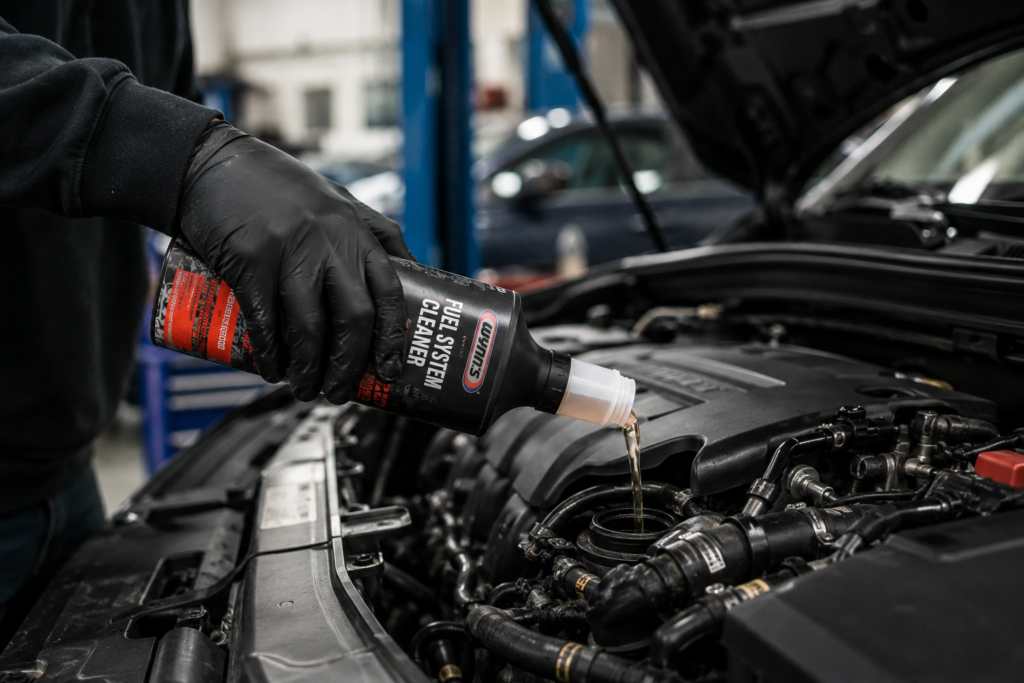
Fuel system cleaners are additives poured directly into the fuel tank. As the fuel moves through the system, the cleaner is designed to remove deposits and carbon build-up from components such as injectors and intake valves.
The aim is to improve combustion efficiency.
When fuel injectors become dirty, the spray pattern becomes uneven. Instead of a fine mist, fuel may enter the engine in larger droplets, which burn less efficiently and produce higher emissions.
A decent cleaner may help by:
- Cleaning injectors
- Removing carbon deposits
- Improving fuel atomisation
- Reducing exhaust smoke
- Helping combustion run more smoothly
Some products also claim to help clean catalytic converters and DPF systems.
In the UK, common brands include Redex, Cataclean, Wynn’s and Liqui Moly. Opinions vary wildly depending on who you ask. Some drivers swear by them, while others place them firmly in the “snake oil” category.
The truth usually sits somewhere in the middle.
Can a Fuel System Cleaner Help You Pass an MOT?
This is where things get interesting.
If your car is only just over the emissions limit, a fuel system cleaner may genuinely help. There are plenty of examples online where drivers used an additive, drove the car properly afterwards, then passed a retest.
That is because the cleaner may improve combustion enough to lower emissions slightly.
However, the key word here is slightly.
If the issue is relatively mild, such as dirty injectors or carbon build-up, a cleaner can sometimes tip the balance in your favour. This is especially true for cars that spend most of their life pottering around town.
Where fuel cleaners may help:
- Borderline emissions failures
- Mild injector contamination
- Carbon build-up from short journeys
- Rough running caused by dirty fuel systems
- Diesel soot accumulation
Where they probably will not help:
- Failed catalytic converters
- Broken DPF systems
- Faulty sensors
- Serious engine faults
- Engine management warning lights
- Mechanical wear
If your catalytic converter has completely given up, no £15 bottle from the motor factors is going to stage a heroic comeback.
At that point, proper diagnostics are the only sensible route.
Petrol vs Diesel: Does It Make a Difference?
Yes, quite a big one.
Petrol Cars
Petrol engines usually fail emissions tests because of issues affecting combustion efficiency or catalytic converter performance.
Common causes include:
- Worn spark plugs
- Faulty ignition coils
- Lambda sensor problems
- Carbon deposits
- Injector contamination
A fuel system cleaner may help if the issue is caused by dirty injectors or carbon build-up. Premium fuel and a good motorway run can also make a noticeable difference before the MOT.
Diesel Cars
Diesel engines are a different beast entirely.
Modern diesels rely heavily on DPF systems and exhaust gas recirculation systems to control emissions. Unfortunately, they also clog up more easily, especially if driven mainly on short journeys.
This is why many diesel owners are advised to take the car for an “Italian tune-up” before an MOT. Despite the dramatic name, it basically means giving the car a proper motorway run at sustained higher revs to help clear soot deposits.
In many cases, a long motorway drive before the test can be more effective than leaving a bottle of additive rolling around in the boot for six months.
That said, diesel injector cleaners can still help improve combustion and reduce smoke in lightly contaminated systems.
What Should You Do Before an MOT Emissions Test?
If you are worried about emissions, there are a few sensible steps worth taking before the test.
Give the Car a Proper Drive
A fully warmed-up engine runs cleaner than a cold one. Taking the car for a decent motorway drive beforehand can help clear soot and deposits.
Use a Quality Fuel
Premium fuels often contain better detergents and cleaning agents which may help combustion efficiency.
Consider a Reputable Fuel Cleaner
If the car has been running rough or mostly doing short journeys, a fuel cleaner may be worth trying a week or two before the MOT.
Just follow the instructions properly. Pouring three bottles into the tank the night before is unlikely to unlock hidden race car performance.
Check Warning Lights
If the engine management light is on, get the fault diagnosed before the MOT. Additives will not fix electrical or sensor problems.
Make Sure Servicing Is Up to Date
Old air filters, worn spark plugs and overdue oil changes can all affect emissions levels.
Basic maintenance matters far more than miracle cures.
Are Fuel Additives Worth It?
For preventative maintenance, yes, they can be.
Using a quality fuel system cleaner occasionally may help keep injectors cleaner, improve running and reduce carbon build-up over time.
What they are not is a substitute for proper repairs.
Think of them more like a toothbrush than dental surgery. Helpful for maintenance, useless if the tooth has already fallen out.
Drivers who regularly use additives often report smoother running, slightly improved fuel economy and less smoke. Others notice absolutely no difference whatsoever.
Vehicle condition, mileage and driving habits all play a role.
When Should You Visit a Garage Instead?
If your car is showing any of the following symptoms, it is time for proper diagnostics rather than another bottle of cleaner:
- Engine warning lights
- Excessive smoke
- Rough idling
- Strong fuel smells
- Poor fuel economy
- Loss of power
- Repeated MOT failures
Modern engines are packed with sensors and emissions systems, and guessing can quickly become expensive.
A proper diagnostic inspection can identify the real issue before money gets wasted replacing parts that were never faulty in the first place.
At Windmill Garage, we regularly see cars where owners have spent money chasing internet fixes when the actual fault turned out to be something simple. Honest advice and accurate diagnostics usually save far more money in the long run.
Answer: Sometimes, Yes
So, does a fuel system cleaner help MOT emissions?
Sometimes, yes.
If your car has mild carbon build-up, dirty injectors or spends most of its life on short journeys, a quality cleaner combined with a good motorway drive may genuinely improve emissions enough to help pass an MOT.
What it will not do is repair major faults or replace proper servicing and diagnostics.
Like most things in motoring, maintenance beats miracles every time.