
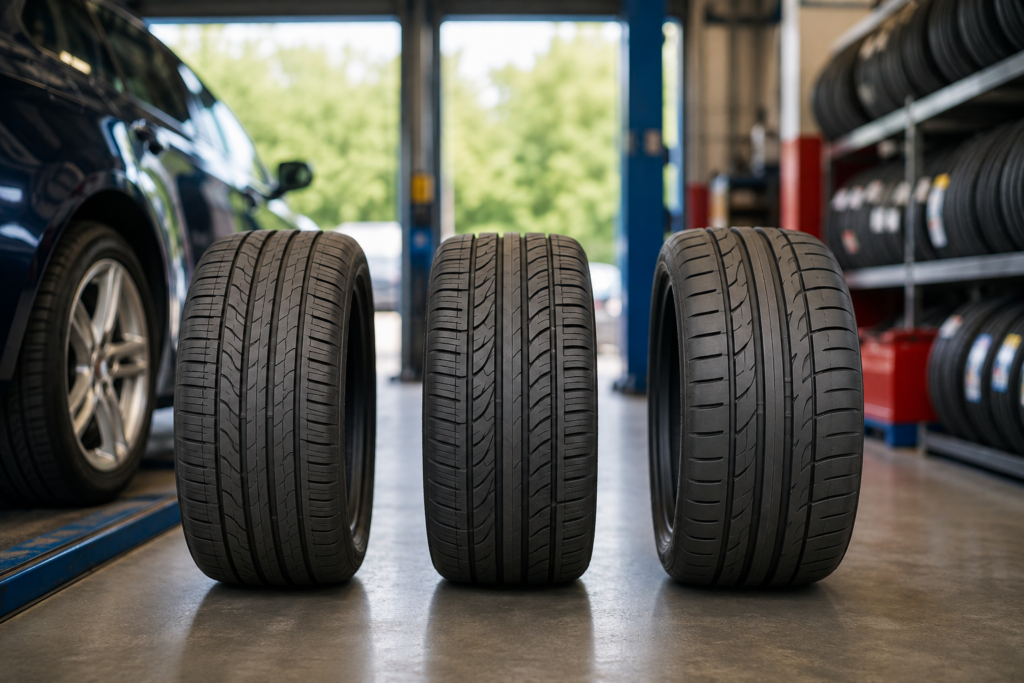
If you are choosing new tyres, the honest answer is that you do not always need the most expensive option. A decent budget tyre can make sense for a low-mileage car doing mainly local journeys, while regular motorway driving, wet-weather use and heavier or more powerful cars give you stronger reasons to spend more.
The important bit is choosing the right tyre for the car and the way you actually use it. Not simply the name on the sidewall.
What are you actually paying for with a more expensive tyre?
All new road tyres sold for use in the UK must meet the relevant requirements, but that does not mean every tyre performs identically.
Tyre manufacturers make different choices around rubber compounds, tread design and construction. Those differences can affect wet braking, handling, rolling resistance, noise, wear and how the tyre behaves as the tread gets older.
For an ordinary family car, three things are particularly worth considering.
Wet grip
This is the big one for Hampshire driving. We are not exactly short of rain.
A tyre needs to clear water from underneath its tread while maintaining contact with the road. Better wet-weather performance can mean more predictable grip and shorter braking distances when the road is soaked.
That matters on a motorway at 70mph far more than it does while pottering a couple of miles to the shops. Same tyre, very different job.
How long the tyre lasts
The cheapest tyre on the day is not automatically the cheapest tyre over several years.
Tyre life depends on the compound, construction, mileage, driving style, pressures, alignment and the car itself. A more expensive tyre may wear more slowly, but price alone is no guarantee of longevity.
Keeping the pressures correct and dealing with uneven wear matters whichever tyre you buy. Our guide to regular tyre rotation and tyre life explains another way tyre wear can sometimes be managed, where rotation is appropriate for the vehicle.
Noise and efficiency
Tyres also affect how much energy your car needs to keep moving and how much external rolling noise they produce.
That does not mean buying the quietest label automatically gives you the quietest cabin, because the official noise figure measures noise outside the vehicle. It is still useful information, particularly when comparing otherwise similar tyres.
The tyre label decoded
New tyres come with standardised performance information covering fuel efficiency, wet grip and external rolling noise. In Great Britain, the current government guidance describes ratings from A, the highest-performing class, to G, the lowest.
Think of the label as a useful comparison tool rather than the entire story.
Fuel efficiency
The fuel-efficiency rating measures rolling resistance. In simple terms, a tyre that takes less energy to roll can reduce the amount of fuel, or battery energy in an electric car, needed to move the vehicle.
An A rating is better than a lower rating.
The difference matters more if you cover plenty of miles. If your car does 2,000 miles a year around Horndean, it is unlikely to be the only thing worth basing your decision on.
Wet grip
This rating relates to wet braking performance.
Again, A is the highest-performing class. For a family car regularly carrying people on the A3(M), motorway or longer wet journeys, this is a figure we would pay attention to.
One caution is worth knowing. The label covers specific standardised tests, not every aspect of how a tyre behaves on the road. DVSA market-surveillance work has also found examples where tested tyres did not initially meet one or more manufacturer-declared label values, which is another reason not to choose solely by the sticker.
External rolling noise
The label gives an external noise measurement in decibels.
External is the important word. It is not a direct measurement of how noisy the tyre will sound from the driver’s seat.
[IMAGE: example UK tyre label showing fuel efficiency, wet grip and external rolling noise ratings]
Budget vs mid-range vs premium tyres: which should you buy?
There is no useful rule saying premium is always right and budget is always wrong. We’d rather look at the car, mileage and type of driving.
Budget tyres
Budget tyres can be a perfectly reasonable choice for some drivers.
If you have a modest family hatchback doing relatively low mileage, mostly around town at lower speeds, spending heavily on premium tyres may not give you enough benefit to justify the extra cost.
We would still look carefully at the individual tyre’s specification, wet-grip rating and suitability for the car. “Budget” should mean less expensive, not simply unknown and chosen because it was at the top of the cheapest-first list.
Mid-range tyres
For plenty of ordinary drivers, this is the sensible middle ground.
A good mid-range tyre can offer a useful balance between purchase price, wet-weather performance, noise and wear. If your car does a mixture of school runs, commuting and occasional longer journeys, this is often where the conversation starts.
Not automatically where it ends. We will still look at the particular tyre and your use of the car.
Premium tyres
There are situations where spending more makes considerably more sense.
If you do substantial motorway mileage, regularly drive long distances in wet weather, carry the family and luggage or have a heavier, powerful or performance-focused car, we would be reluctant to choose tyres purely on the lowest price.
Motorway speeds put a different set of demands on a tyre. So do heavy rain, emergency braking and a fully loaded car.
You do not need a track tyre for the school run. You do want something appropriate for the work you are asking it to do.
Should tyres match across an axle?
Ideally, we like tyres across the same axle to be closely matched, particularly in size, type and performance characteristics.
There are also legal requirements involved. The current MOT inspection manual states that tyres on the same axle being different sizes is a major defect, as is mixing tyres of different structures such as radial and cross-ply on the same axle.
Having the same make and model on both sides is not itself a general MOT requirement. However, fitting matching tyres where practical gives the two sides of an axle more consistent characteristics for grip, braking and water clearance.
There can also be vehicle-specific requirements, particularly with four-wheel-drive systems and specialist tyre fitments. If there is any doubt, we check the correct specification rather than guessing.
What about part-worn tyres?
Part-worn tyres can legally be sold in Great Britain if they meet specific requirements. Among other things, qualifying tyres must be in suitable condition and carry the required permanent “PART-WORN” marking. Government guidance for operators also sets out requirements around tread, structural condition and repairs.
Legal does not necessarily make them our preferred option.
We do not fit part-worn tyres. With a new tyre, you know what you are starting with. With a used one, its previous treatment, pressures, impacts and storage are not always obvious from looking at the tread.
For something responsible for keeping the car in contact with the road, we would rather start with a known quantity.
When should you replace your tyres: 3mm or 1.6mm?
For cars and light vans, the UK legal minimum is 1.6mm across the central three-quarters of the tread, around the entire circumference of the tyre. That remains the law in 2026.
You will often hear advice to replace tyres at 3mm. That is advice, not the legal limit.
There is a genuine reason behind it. Tread has to shift water, and wet-weather performance can deteriorate as it wears. TyreSafe currently advises motorists to consider replacement at 3mm, noting the increased aquaplaning risk as tread falls below that point.
There is some disagreement within the tyre industry about treating 3mm as a universal replacement point. Michelin, for example, says its tyres are designed to remain safe down to the legal 1.6mm limit.
Our view is simpler: 1.6mm is the law, 3mm is a useful point to start paying much closer attention. Condition, wear pattern, time of year and the journeys you make all matter. We will tell you what needs replacing and what can reasonably wait.
For checking yours at home, read our guide to tyre tread depth and the MOT.
Need new tyres in Horndean?
We can supply tyres for most makes and models, including budget and performance options, as part of our other vehicle services.
Tyre prices depend on the exact size and specification, so there is no honest single price we can print here. Give us a ring on 02392 571003 with your tyre size and we can quote for suitable options rather than selling you a tier you do not need.
The size is written on the tyre sidewall and looks something like 205/55 R16 91V. If you are not sure what you are looking at, we can help.
[IMAGE: where to find the tyre size on the sidewall, highlighting an example such as 205/55 R16 91V]
Frequently asked questions
Are budget tyres safe?
New tyres sold for road use must meet the relevant legal requirements, but that does not mean all tyres have identical wet braking, handling, noise or wear characteristics. A budget tyre can be a sensible choice for some lower-mileage drivers. We would judge the individual tyre and how the car is used.
Are premium tyres worth the extra money?
They can be. Regular motorway mileage, wet-weather driving, heavier cars and higher-performance vehicles are all good reasons to consider spending more. For a lightly used town car, a good mid-range or budget option may be enough.
Do both tyres on the same axle need to be the same brand?
There is not a general MOT rule requiring the same brand on both sides. However, tyres on the same axle must meet requirements covering matters such as size and structure, and matching the make and model where practical can give more consistent performance.
Is 3mm the legal tyre tread limit?
No. The legal minimum for cars is 1.6mm across the central three-quarters of the tread and around its entire circumference. The commonly quoted 3mm figure is safety advice, particularly because wet-weather performance can decline as tread wears.
Can you fit part-worn tyres?
No. We fit new tyres rather than part-worn ones. Give us your tyre size and we can talk through suitable budget, mid-range and premium choices.
How do I know which tyre size I need?
Look at the markings on the sidewall of your existing tyre. You will see a sequence similar to 205/55 R16 followed by load and speed ratings. If you are unsure, call us on 02392 571003 and we will help you identify what you need.
Book your MOT or service in under a minute
If your tyres are getting low, wearing unevenly or you simply want a straight answer on whether they need replacing, we can check them and talk you through the options.
Book online any time at https://www.windmillgarage.co.uk/book-in-your-car/ or call us on 02392 571003 (Mon–Fri, 8.30am–5pm).