
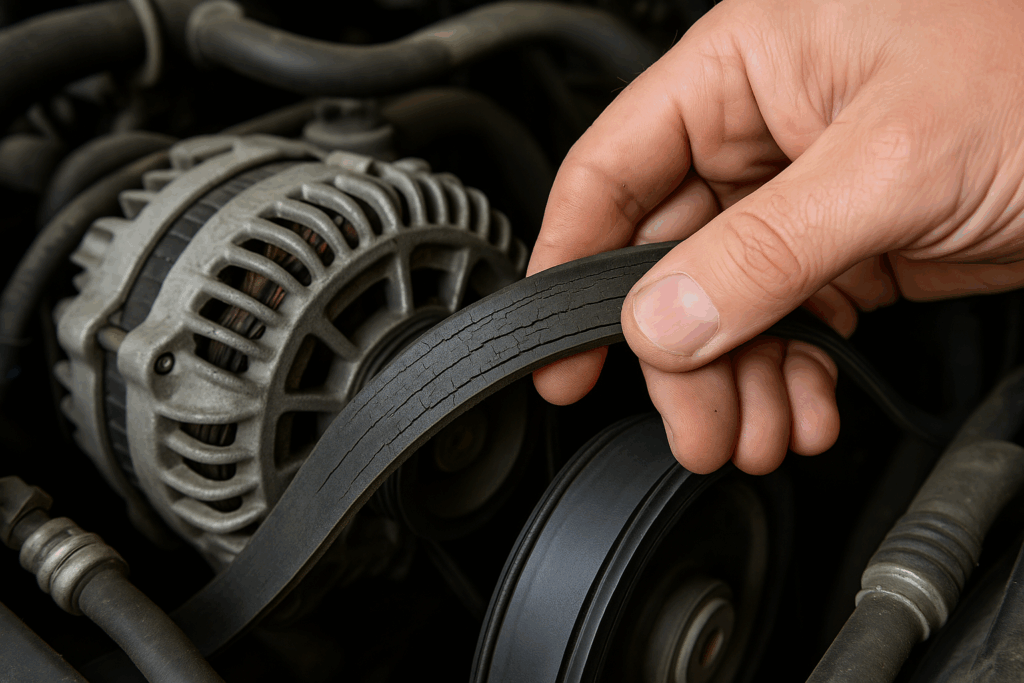
A squeal on a cold start, a chirp when you put the air conditioning on, or a battery warning light can all point towards a problem with your car’s drive belt. It is a relatively simple part, but if it snaps it can leave you at the roadside and, on some engines, lead to overheating.
The drive belt is also called an auxiliary belt or serpentine belt. Whatever name your handbook uses, it is worth knowing what it does, how to spot wear and when to get an unfamiliar noise checked.
What is a drive belt?
Your engine produces the power to move the car, but it also needs to run several other components. The drive belt transfers some of that power from the engine’s crankshaft to equipment around it.
Depending on the car, the belt may drive the:
- alternator
- air-conditioning compressor
- hydraulic power-steering pump
- water pump
- other auxiliary components
Not every car uses its drive belt for all of these. Electric power steering is common on newer cars, for example, and water pumps can be driven in several different ways.
Many modern cars use one long, ribbed belt routed around several pulleys. This is often called a serpentine belt because of the way it snakes around the engine. Older cars may use more than one separate auxiliary belt.
Drive belt vs timing belt: what is the difference?
They are easy to confuse, particularly because both are often rubber belts somewhere around the engine. They do very different jobs.
| Drive belt / auxiliary belt | Timing belt / cambelt | |
|---|---|---|
| Main job | Drives equipment such as the alternator and air conditioning | Keeps the crankshaft and camshaft correctly synchronised |
| Where is it? | Usually visible around the outside of the engine | Usually behind a protective cover |
| What happens if it fails? | You may lose charging, power steering or cooling, depending on the engine | On many engines, failure can cause serious internal engine damage |
| Replacement interval | Depends on the manufacturer and vehicle | A specific age and/or mileage interval is normally set by the manufacturer |
| Can you inspect it yourself? | Often, at least partially | Usually not without removing covers |
A broken drive belt can certainly cause trouble, but it is not the same thing as a broken timing belt.
If it is the timing belt you are concerned about, read our guide here: https://www.windmillgarage.co.uk/maintenance/how-to-maintain-your-cars-timing-belt-for-peak-performance/
What are the signs of a worn drive belt?
Drive belts do not always give much warning before failing. When they do, though, there are a few useful clues.
A squeal on cold start
A high-pitched squeal just after starting the engine is one of the better-known drive belt symptoms. You may notice it more on a cold or damp morning, then hear it fade as the engine warms.
The belt itself could be worn or slipping, but don’t assume that fitting a new belt automatically solves it. Incorrect tension, pulley alignment or a worn tensioner can produce similar noises.
The noise is the clue. Finding the cause is the important bit.
A chirp under load
A shorter, repetitive chirping noise can appear when extra load is placed on the auxiliary drive system. You might notice it when the air conditioning operates, for example.
A chirp can point towards belt wear or contamination, but it may also come from a pulley, tensioner or alignment problem. If the noise keeps returning, particularly if it is getting louder, it is worth having the whole belt drive inspected rather than simply changing the belt.
A battery warning light
The drive belt commonly turns the alternator, which charges the car’s battery while the engine is running.
If the belt slips badly or breaks, the alternator may stop charging. A battery or charging-system warning light can then appear on the dashboard.
That doesn’t automatically mean the belt is at fault. Charging problems have several possible causes, so this is one for proper diagnosis rather than parts bingo.
Heavy steering
Cars with a belt-driven hydraulic power-steering pump can suddenly become much harder to steer if the belt fails.
Many newer cars use electric power steering and will behave differently, so the symptoms depend on the vehicle.
Rising engine temperature
On engines where the auxiliary belt drives the water pump, belt failure can stop coolant circulating properly and cause the engine temperature to rise quickly.
Treat an overheating warning seriously. Continuing to drive an overheating engine can turn a fairly ordinary belt problem into a much larger repair.
How to check a drive belt for wear
You can often make a basic visual check yourself. Do it only with the engine switched off, cool and the keys safely away from the ignition.
Find the auxiliary belt and look along as much of its length as you can see. You are looking for:
- obvious cracking
- frayed or damaged edges
- missing pieces or ribs
- shiny, polished or glazed areas
- contamination from oil or coolant
- a belt that appears to be running incorrectly on a pulley
A little surface ageing does not necessarily mean the belt is about to snap. Modern belt materials can also wear without developing the dramatic cracks people expect, so appearance is only part of the picture.
Do not put your hands near a moving belt to investigate a noise. A running auxiliary drive has plenty of enthusiasm and very little sympathy for fingers.
[IMAGE: side-by-side close-up photographs of a cracked drive belt and a shiny/glazed drive belt, clearly labelled]
If the belt is badly frayed, has missing sections or is contaminated, get it checked rather than waiting to see what happens.
When should a drive belt be replaced?
There is no single replacement interval that applies to every car.
Some general UK maintenance guidance puts auxiliary belt life somewhere around 60,000 to 100,000 miles, but that is only a broad guide. The correct interval for your car is the one specified by its manufacturer, which may use mileage, age or both. Some belts last considerably longer than others.
Condition matters too. Heat, oil contamination, a worn tensioner, pulley problems and the way the belt has been running can shorten its life.
A sensible approach is to have the belt looked at during routine servicing and check the manufacturer’s maintenance schedule rather than treating a generic mileage figure as a deadline. Haynes likewise recommends examining auxiliary belts whenever the car is serviced.
If you have bought a used car and there is no record of the belt’s age, ask your garage to inspect it at the next service.
How much does drive belt replacement cost?
There isn’t a useful one-price-fits-all answer.
Current UK guides put straightforward auxiliary belt replacement broadly in the tens to low hundreds of pounds, with one national guide quoting roughly £80 to £250. The actual bill depends heavily on the car, access to the belt and whether the belt alone needs changing or there is also a worn tensioner or pulley.
We would rather give you the right figure for your car than publish a tempting number that bears no relation to the job once the bonnet is open. Our current published prices are at https://www.windmillgarage.co.uk/prices/, or call us on 02392 571003 for advice.
What happens if a drive belt snaps while driving?
The first rule is not to assume you can carry on to your destination.
Exactly what happens depends on what that particular belt drives. You could see the battery warning light because the alternator has stopped charging. Hydraulic power steering may become much heavier. Air conditioning may stop working.
More importantly, if the belt drives the water pump, the engine can begin overheating. A failed or shredded belt can also cause secondary damage around the pulleys and surrounding components.
If you hear a sudden noise followed by warning lights, heavy steering or a rising temperature gauge, find a safe place to stop as soon as you can. Switch the engine off and arrange recovery if necessary.
Do not keep driving an overheating car in the hope that it will make it home. Sometimes optimism is an expensive engine component.
Does a squealing drive belt always need replacing?
No. The belt is one possibility, not the only one.
A tensioner keeps the correct load on the belt, while idler and accessory pulleys allow it to follow the proper route. Wear, bearing problems or misalignment in these parts can produce noises that sound very much like a worn belt.
Oil or coolant contamination can cause trouble too.
That is why diagnosis matters. Replacing a belt without finding out why it was slipping, running out of line or wearing unevenly can leave you with the same noise and a newer belt.
If yours is squealing, chirping or behaving oddly, we can inspect the belt and associated components and tell you what needs doing now and what can wait. Windmill Garage is a family-run garage at 249 London Road, Horndean, and we’ve been looking after local drivers for over thirty-five years.
Drive belt FAQs
Is a drive belt the same as a serpentine belt?
Usually, yes. “Drive belt”, “auxiliary belt” and “serpentine belt” are commonly used for the belt or belts driving accessories such as the alternator and air-conditioning compressor. The exact terminology varies between manufacturers.
Is a drive belt the same as a timing belt?
No. A timing belt synchronises internal engine operation. The auxiliary drive belt powers external components such as the alternator. Their replacement schedules and consequences of failure are different.
Can I drive with a squealing drive belt?
A brief squeal does not tell you exactly what is wrong, so it is better to have the cause checked rather than guessing. If the noise is persistent, getting worse or accompanied by warning lights, overheating or heavy steering, stop driving and get advice.
Can I inspect the drive belt myself?
You can make a visual check on many cars with the engine switched off and cool. Look for fraying, missing sections, cracking, glazing and contamination. Keep hands, clothing and tools well away from the belt whenever the engine is running.
Should the tensioner be replaced with the belt?
Not automatically. It depends on its condition and the manufacturer’s procedure for that vehicle. A worn tensioner or pulley should not be ignored, though, because fitting a fresh belt does not repair the component that caused the problem.
Book your MOT or service in under a minute
If your drive belt is squealing, chirping or simply looking past its best, we can inspect the belt and diagnose what’s causing it before changing parts unnecessarily.
Book online any time at https://www.windmillgarage.co.uk/book-in-your-car/ or call us on 02392 571003 (Mon–Fri, 8.30am–5pm).