
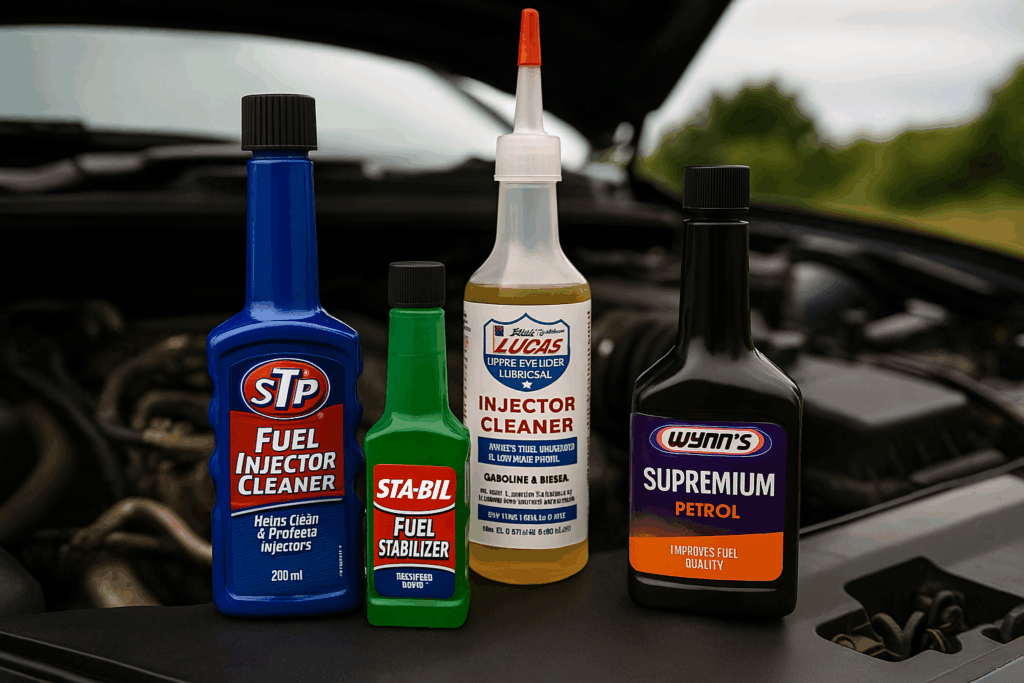
Fuel additives can work, but most cars do not need a bottle poured into the tank every few weeks. They make most sense when there is a particular job to do, such as helping a lightly sooted older diesel, cleaning fuel-system deposits or protecting petrol in a car that will be stored for a while.
Our workshop view is fairly simple: use the right additive for the right reason. If there is an actual mechanical fault, save your money and fix the fault.
What are fuel additives?
Fuel additives are concentrated chemicals added to petrol or diesel. Different products do different jobs, which is the first thing worth understanding before reaching for whichever bottle has the most convincing label.
Common types include:
- Petrol and diesel injector cleaners, intended to remove or reduce deposits around fuel injectors and elsewhere in the fuel system.
- DPF additives, designed to help the regeneration process that burns soot from a diesel particulate filter.
- Fuel system cleaners, which make broader claims around deposits, combustion and emissions.
- Fuel stabilisers, mainly intended for petrol vehicles that spend long periods unused.
- Octane or cetane improvers, which alter certain combustion properties of petrol or diesel.
- Specialist additives for older vehicles, including lead-replacement products where appropriate.
Most modern pump fuel already contains an additive package, so buying another bottle is not automatically necessary. That is an important bit the front of the bottle tends not to dwell on.
Do fuel additives actually work?
Some do, within limits.
A decent injector cleaner can help where deposits are affecting the injector spray pattern or combustion. A DPF additive can sometimes help a diesel complete regeneration more readily. A fuel stabiliser can be useful before a petrol vehicle is laid up for an extended period.
What none of them can reliably do is repair a failed injector, replace a blocked fuel filter, cure a faulty sensor, mend an air leak or turn a heavily blocked DPF back into a healthy one.
That distinction matters.
If your car is starting normally, pulling properly, returning its usual fuel economy and showing no warning lights, regularly adding cleaners may achieve very little. You could simply be treating a problem you haven’t got.
The three additives most drivers actually ask us about
Injector cleaners
Petrol and diesel injector cleaners contain detergents intended to tackle deposits within the fuel system and around the injectors.
Current UK retail prices vary considerably. Basic bottles can be roughly £5 to £10, with stronger or more comprehensive treatments often around £15 to £20 or more. These are retail-market ranges rather than Windmill Garage prices, and they will change.
For example, current listings put Redex diesel system cleaner at about £5.50, while STP petrol and diesel injector cleaners can be found at roughly £8 to £9. More comprehensive fuel and exhaust cleaners can cost nearer £18.
Would we put injector cleaner into every healthy car at every service? No.
Would we consider a reputable cleaner on an older vehicle that has spent years doing short trips and appears to have some deposit-related running issues? Possibly. It can be a relatively inexpensive thing to try when the symptoms and condition of the car make sense.
If it makes no difference, don’t keep pouring bottles in hoping number four will suddenly discover something bottles one to three missed.
DPF additives
A diesel particulate filter, or DPF, traps soot from the exhaust. The car periodically raises exhaust temperatures to burn much of that soot away in a process called regeneration.
Short journeys can make that difficult. The engine may repeatedly be switched off before the conditions needed for regeneration are reached.
Some DPF additives are designed to make soot easier to burn during regeneration. Current UK products are commonly around £10 to £20 a treatment, depending on the product. A Wynn’s DPF cleaner, for example, is currently listed at about £10, while Cataclean Diesel is around £18. Manufacturer claims vary, so treat the bottle as an aid rather than a promise.
A DPF additive may be worth considering if the filter is accumulating soot but is still capable of regenerating.
It will not fix every DPF problem.
A DPF can contain soot, which regeneration can burn, but it also accumulates non-combustible material over its working life. There can also be underlying faults involving pressure sensors, temperature sensors, injectors, the EGR system or the regeneration process itself.
If the warning light keeps returning, the car has gone into reduced-power mode or regeneration continually fails, it needs diagnosing rather than another bottle.
In the workshop, that is the difference between treating the symptom and finding out why it is there.
When fuel additives genuinely make sense
An older diesel before an MOT emissions test
This is one of the more reasonable uses.
An older diesel that has spent months doing short local journeys can arrive for its MOT carrying considerably more soot than one that regularly gets properly warm. If the car is otherwise healthy, an appropriate diesel cleaner followed by a decent run can sometimes help clean up combustion and give the exhaust system the conditions it needs to work properly.
The important words there are otherwise healthy.
An additive will not legally or mechanically disguise missing emissions equipment, and it will not reliably rescue a car with a genuine injector, EGR, turbo, sensor or DPF fault.
More on preparing a diesel properly here:
A car coming out of storage
Fuel stabiliser is a different proposition because it is normally used to prevent a problem rather than cure one.
It can make sense for a petrol classic, second car or other vehicle that spends months sitting unused. UK-market fuel stabilisers start at roughly £10 to £15 a bottle, with bottle size and treatment capacity varying.
Standard 95-octane petrol in Great Britain is E10, meaning it can contain up to 10% ethanol. All petrol cars built since 2011 are compatible with E10 and the large majority of older petrol cars are too, although older vehicles should be checked if there is any doubt.
If a vehicle is going into long-term storage, follow the additive manufacturer’s dosing instructions and the vehicle manufacturer’s advice. Don’t assume twice the additive gives twice the protection.
It doesn’t work like squash.
A vehicle with light deposit-related symptoms
A cleaner may also be worth trying where there is a reasonable suspicion of fuel-system deposits and no obvious mechanical failure.
The important part is knowing when to stop experimenting.
If the engine-management light is on, the car is misfiring, struggling to start, smoking noticeably or has lost significant power, get the fault diagnosed. Modern engines monitor themselves remarkably closely, and fault codes and live data are considerably more useful than guessing from the additives shelf.
When fuel additives are a waste of money
For a healthy modern car driven regularly and serviced properly, routine additives are often unnecessary.
We would be particularly sceptical where an additive is being used to:
- chase a tiny claimed improvement in MPG
- cure a persistent engine warning light
- compensate for repeatedly interrupted DPF regeneration
- fix a known faulty injector
- avoid overdue servicing
- mask visible exhaust smoke
- cure a serious loss of power
- postpone investigating an emissions fault
Sometimes a customer will describe an additive as having transformed a car. Sometimes there is a genuine improvement. In other cases, the car has just had a long, hot run at the same time, which itself may have helped.
That is why we prefer diagnosis to guesswork.
What we actually see inside engines and fuel systems
Additive adverts tend to show a dramatic before-and-after picture: filthy component on one side, spotless component on the other.
Real cars are less tidy.
Deposits can build around injectors and throughout combustion and emissions systems, particularly as mileage rises and where a vehicle does repeated short journeys. Diesel EGR systems and intake components can become heavily contaminated with carbon and oily deposits. DPFs collect soot by design and, over time, material that regeneration cannot simply burn away.
A small quantity of cleaner travelling through the fuel system is not the same as physically removing a heavily contaminated component and cleaning, repairing or replacing it.
That does not make additives useless. It just gives them a sensible place in the toolbox.
They are maintenance products and, occasionally, useful first steps. They are not liquid engine rebuilds.
Will an additive help me pass the MOT emissions test?
It might help a healthy but sooty car, particularly an older diesel that has spent a lot of time doing short journeys. It cannot guarantee an MOT pass.
Under the current DVSA MOT inspection rules, diesel emissions are tested against the vehicle’s applicable smoke-opacity limit. Where a diesel is fitted with a DPF, visible smoke during the metered check is also a major defect. Missing, obviously modified or defective emissions-control equipment can cause a failure too.
The engine should also be properly warm for the diesel smoke test. DVSA guidance says the engine temperature should be above 80°C or at its normal operating temperature, whichever is lower.
So if your diesel has an MOT approaching, the sensible preparation is not to pour something in the tank five minutes before arriving.
Check the car has no warning lights or obvious faults. If an appropriate additive is being used, follow its instructions. Then give the vehicle enough normal driving to get fully up to temperature and, where suitable for the vehicle and road conditions, allow the engine and exhaust system a sustained run.
For a fuller guide, read our diesel smoke-test advice:
And if the car is smoking heavily or has an engine or DPF warning light, get that investigated before the MOT. A bottle is not a repair.
Can fuel additives damage an engine?
The correct additive, used at the correct dose in a compatible vehicle, should be used according to its manufacturer’s instructions. Problems become more likely when people start improvising.
Check whether the product is intended for petrol or diesel, whether it is compatible with your engine and emissions system, and how much fuel one bottle is designed to treat.
More is not necessarily better.
Be particularly careful with older and unusual vehicles, classics and cars where the manufacturer specifies particular fuel requirements. If the handbook warns against aftermarket additives, follow the handbook.
And never put an additive into a fluid reservoir simply because the bottles happen to live near each other on a motor-factors shelf. Fuel-tank additives go in the fuel tank unless their instructions explicitly say otherwise.
Fuel additives: our workshop verdict
Our answer after more than thirty-five years looking after cars in Horndean is neither “they’re brilliant” nor “they’re all snake oil”.
Some have a job.
An injector cleaner can be worth trying for light deposit-related problems. A DPF additive may help a functioning system regenerate under the right conditions. A fuel stabiliser is sensible for some cars going into storage. An older, sooty diesel approaching its emissions test may also benefit from the right treatment and a proper run.
But if a healthy modern car is running exactly as it should, we would not tell you it needs a cupboard full of additives.
And if the car has a genuine fault, spend the money finding the fault instead.
If you’re unsure which camp yours falls into, give us a call on 02392 571003 or contact us at https://www.windmillgarage.co.uk/contact-us/. We’ll tell you whether it sounds like something simple you can try yourself or whether the car needs looking at.
Our current garage prices are published at https://www.windmillgarage.co.uk/prices/.
Frequently asked questions
Should I use fuel additive every time I fill up?
Usually not unless the product or vehicle manufacturer specifically calls for regular treatment. Most healthy modern cars should run perfectly well on the correct pump fuel without an aftermarket additive at every fill.
Are diesel additives worth using?
Sometimes. They can make sense for an older diesel doing lots of short journeys, or where a specific injector or DPF treatment is appropriate. Persistent smoke, warning lights or poor running need investigation rather than repeated additives.
Can DPF cleaner unblock a DPF?
It may help a soot-loaded DPF regenerate if the system is otherwise working correctly. It cannot fix every blockage or the underlying fault that caused one. Heavily blocked filters may need workshop diagnosis and cleaning or repair.
Can injector cleaner fix a faulty injector?
It can help with some deposits, but it cannot repair a mechanically or electrically faulty injector. If symptoms persist, the fuel system needs testing.
Can a fuel additive guarantee an MOT emissions pass?
No. An additive may help a healthy vehicle where deposits or soot are contributing to emissions, but there is no guaranteed pass. The vehicle still has to meet the MOT requirements in its condition at the time of the test.
Book your MOT or service in under a minute
If your car is smoking, running poorly or you’re wondering whether an additive will actually help, we can check the problem before you spend money guessing.
Book online any time at https://www.windmillgarage.co.uk/book-in-your-car/ or call us on 02392 571003 (Mon–Fri, 8.30am–5pm).