
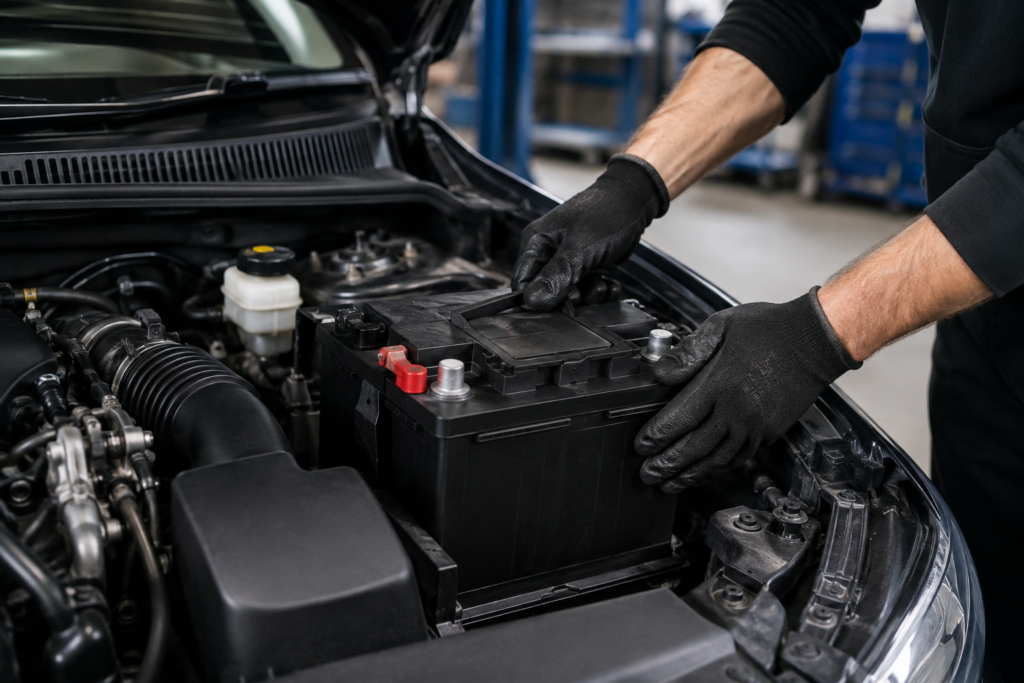
If your car is slow to start, keeps needing a jump or has suddenly become rather reluctant on cold mornings, the battery is worth checking before it leaves you stuck somewhere inconvenient. We test and replace car batteries at Windmill Garage in Horndean, making sure the replacement is the right type for the car and, where required, correctly registered with its battery management system.
Not every starting problem means you need a new battery. Testing it first gives us a much better idea of what is actually going on.
Five signs your car battery may be going
A failing battery does not always go from working perfectly to completely dead overnight. Often, there are warnings first.
1. The engine turns over slowly
You turn the key or press the start button and the engine cranks more slowly than usual. It might still start, but that sluggish first turn is one of the classic signs that the battery is struggling to supply enough power.
If it happens repeatedly, get it checked rather than waiting for the morning when it does not turn over at all.
2. The lights seem dim
Headlights, interior lights or dashboard illumination that noticeably dim while the engine is off can point towards a weak battery.
That said, electrical symptoms can have other causes. A charging fault, poor connection or another electrical problem can produce similar behaviour, which is why testing beats guessing.
3. You’ve needed more than one jump start
One flat battery can happen because somebody left a light on. These things happen.
If the car needs repeated jump starts without an obvious reason, something needs investigating. The battery may no longer be holding charge properly, or the problem could lie elsewhere in the charging or electrical system.
4. A battery or charging warning appears
A dashboard battery symbol does not automatically mean the battery itself has failed. It can indicate a problem with the vehicle’s charging system, including the alternator.
If the warning stays on while the engine is running, have the car checked.
5. The battery is getting old
There is no exact birthday on which a car battery gives up, but three to five years is a common working life. How the car is driven, where it is kept and the demands placed on its electrical system all make a difference.
If yours is around that age and starting is becoming less convincing, a battery test is sensible.
How long does a car battery last?
For many cars, somewhere around three to five years is typical. Some last longer and some considerably less.
Short journeys are particularly hard on batteries. Starting an engine takes a fair amount of energy, and a five-minute school run or quick trip to the shops may not give the charging system enough time to replace what was used. Repeat that pattern often enough and the battery spends much of its life less than fully charged.
Cars that sit unused for long periods can have similar trouble. Alarms, keyless-entry systems and other electronics may continue drawing a small amount of current even when the car is parked.
Cold weather then exposes the problem. Low temperatures reduce a battery’s ability to deliver power, while a cold engine can take more effort to turn. A battery that seemed fine in October can suddenly make its feelings known on the first properly frosty morning.
Our guide to car battery maintenance covers the simple things you can do to help a healthy battery last, while our winter driving guide has more checks worth making before colder weather arrives.
Car battery testing in Horndean
A battery test helps answer the important question: is the battery actually at fault?
[CONFIRM: is battery testing free at Windmill Garage?]
Depending on the vehicle and symptoms, the checks can include the battery’s state of charge and its ability to deliver the current needed to start the engine. Where the symptoms suggest something beyond the battery itself, the charging system may also need checking.
That distinction matters. Replacing a perfectly usable battery will not cure a faulty alternator, poor electrical connection or unwanted battery drain.
If your car is becoming difficult to start, book it in and tell us exactly what it has been doing. The more useful detail the better: slow starting first thing, flat after being parked for two days, warning light appearing while driving. It all helps narrow things down.
Stop-start cars need the right battery
This is where changing a battery has become rather less straightforward than it used to be.
Cars with automatic stop-start systems commonly use EFB or AGM batteries designed to cope with far more frequent starting and greater electrical demands than a conventional starter battery.
EFB stands for Enhanced Flooded Battery. AGM means Absorbent Glass Mat. You do not need to remember the names. What matters is fitting the battery technology specified for the vehicle.
An AGM battery should be replaced with the correct AGM battery. Where a vehicle has an EFB battery, the correct replacement will depend on the manufacturer’s requirements and vehicle specification. Fitting an ordinary conventional battery simply because it fits in the tray is not a sensible shortcut.
Even if you permanently switch off the stop-start button because you find it irritating, that does not necessarily mean you can fit a cheaper conventional battery. The car’s charging and battery management systems were designed around a particular battery type.
Does a new car battery need coding?
On some modern vehicles, yes.
Many cars have a battery management system, usually shortened to BMS, which monitors battery condition and controls how the vehicle charges it. When a replacement battery is installed, some vehicles require the new battery to be registered or programmed into that system using diagnostic equipment.
The exact procedure varies by make, model and year. Not every car needs battery registration, so we would not pretend otherwise.
Where it is required, though, it is part of fitting the battery correctly. The vehicle needs to know that a fresh battery has been installed and, depending on the system, information such as its type and capacity.
This is one reason modern battery replacement can involve more than undoing two terminals and putting another box in the same hole.
Why professional battery fitting matters on modern cars
On an older, relatively simple car, battery replacement can be a straightforward mechanical job. Modern cars may be a different story.
Disconnecting the battery can affect stored settings and vehicle electronics. Some vehicles need a maintained power supply during replacement, while others have specific procedures for disconnecting and reconnecting the battery.
Then there is battery location. It is not necessarily sitting conveniently under the bonnet anymore. Depending on the model, manufacturers put batteries in boots, under covers and elsewhere around the vehicle.
The sensible approach is to identify the correct battery for the specific car, follow its replacement procedure and carry out any battery registration required afterwards. Done properly, returned right.
How much does car battery replacement cost?
There is no honest single price for a replacement car battery because the battery itself varies considerably between vehicles.
A straightforward conventional battery for a smaller car and an AGM battery for a modern stop-start vehicle are different products with different specifications and costs. Battery capacity, physical size, starting performance and vehicle electronics all affect what is required.
[CONFIRM: Windmill Garage battery supply and fitting price range, or preferred wording if batteries are quoted individually]
We will confirm what your particular car needs and agree the price before fitting it. No surprise battery upgrade appearing on the invoice afterwards.
For our published MOT and servicing charges, you can also see the garage’s current prices.
Car battery replacement in Horndean
Windmill Garage is at 249 London Road, Horndean, and we have been looking after local family cars for over thirty-five years.
If you suspect your battery is failing, we can test it, identify the correct replacement where one is needed and fit it properly for the vehicle.
For same-day battery fitting availability, please contact Windmill Garage or call 02392 571003. Battery availability varies by vehicle, so give us your registration when you ring and we can check what yours needs.
We are open Monday to Friday, 08:30 to 17:00.
Frequently asked questions about car batteries
How do I know whether my battery needs replacing?
Slow starting, repeated flat batteries and an ageing battery are all good reasons to have it tested. Testing first is worthwhile because charging-system or electrical faults can sometimes produce similar symptoms.
How long should a car battery last?
Around three to five years is common, although driving pattern, temperature, electrical load and maintenance can all affect battery life. Lots of short journeys can shorten it because the battery may not get enough time to recharge properly between starts.
Can I put a normal battery in a stop-start car?
You should fit the battery technology specified for the vehicle. Stop-start cars commonly require EFB or AGM batteries because they are designed for heavier cycling and electrical demands. If the car uses AGM, the replacement should also be AGM.
Does my new battery need coding?
Some modern cars require a replacement battery to be registered or programmed with the battery management system. Others do not. It depends on the make, model and system fitted, so it should be checked for the particular vehicle rather than assumed either way.
Why does my battery keep going flat?
The battery itself may be worn out, but repeated flat batteries can also be caused by charging problems, electrical drains, poor connections or a pattern of very short journeys. If it keeps happening, the cause is worth finding rather than simply reaching for the jump leads again.
Can you fit my battery today?
Battery availability depends on the vehicle and the correct battery specification. Call us on 02392 571003 during opening hours and give us your registration, or use our contact page to ask about availability. We will not promise same-day fitting until we know we have the right battery available.
Book your MOT or service in under a minute
If your battery is showing its age or the car is getting reluctant to start, getting it checked now is rather easier than discovering it is completely flat when you need to leave.
Book online any time at https://www.windmillgarage.co.uk/book-in-your-car/ or call us on 02392 571003 (Mon–Fri, 8.30am–5pm).