
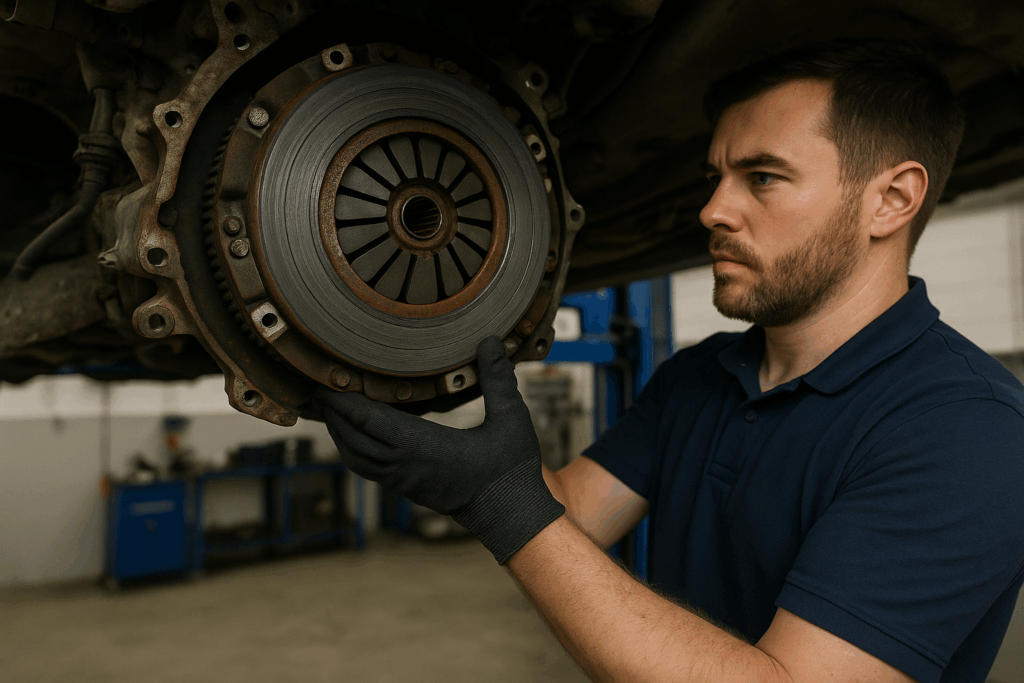
A manual car clutch will often last somewhere between 50,000 and 100,000 miles, but there is no fixed replacement interval. Town driving, school runs and poor clutch habits can shorten its life considerably, while a car doing long motorway journeys may go well beyond 100,000 miles on its original clutch.
If yours is slipping, juddering, biting unusually high or producing a burning smell, get it checked rather than waiting for it to give up altogether. Those symptoms do not automatically mean you need a new clutch, but they are worth investigating.
What does a clutch actually do?
In a manual car, the clutch sits between the engine and gearbox. Pressing the clutch pedal temporarily disconnects the engine from the transmission, allowing you to change gear. Release the pedal and the two reconnect, sending the engine’s power through to the wheels.
Every time you pull away, change gear or manoeuvre at low speed, the clutch is doing some work. It is designed for that. The friction surfaces do wear over time, though, which is why clutch lifespan depends so heavily on how and where the car is driven.
How long does a clutch last?
Around 50,000 to 100,000 miles is a sensible general guide, although some clutches fail earlier and others comfortably pass 100,000 miles. RAC gives a broad potential range of 30,000 to 150,000 miles because vehicle design, condition and driving style make such a difference.
Mileage alone therefore tells us very little. A 60,000-mile car that has spent its life crawling through traffic can have considerably more clutch wear than a 90,000-mile car mainly driven on motorways.
Town driving and the school run
For a car doing mostly short, stop-start journeys, roughly 30,000 to 60,000 miles can be a realistic range before significant clutch wear appears, although a well-driven clutch can certainly last longer.
Think school runs, queues through town, repeated junctions, parking and hill starts. Each one means disengaging and engaging the clutch again. Heavy traffic also encourages drivers to creep forward on the biting point, which adds heat and wear.
The mileage is only a guide, not a countdown clock. If your clutch feels normal at 60,000 miles, there is no reason to replace it simply because the odometer has reached a particular number.
Mixed everyday driving
For a car seeing a mixture of local roads, A-roads and longer journeys, around 50,000 to 100,000 miles is a useful rule of thumb.
Driving technique still matters. Resting your foot on the clutch pedal, holding the car on the clutch on a hill or repeatedly slipping it to creep forward can shorten its life. The AA specifically warns that these habits increase clutch wear.
Mostly motorway driving
A clutch in a car doing regular long-distance motorway journeys may last 100,000 miles or more. Once you are cruising in gear, the clutch is fully engaged and doing very little compared with a car constantly stopping and starting.
RAC notes that motorway journeys generally produce less clutch wear than frequent city driving, while careful driving can see a clutch last beyond 100,000 miles.
So two identical cars with identical mileage can arrive at the workshop with very different clutches. How those miles were covered matters.
Four signs your clutch may be wearing out
Clutches rarely send a polite written warning before they cause trouble. Fortunately, the car usually gives you a few clues.
1. The clutch is slipping
This is one of the clearest signs of clutch wear.
You press the accelerator and the engine revs rise, but the car does not accelerate as strongly as it should. It can be particularly noticeable when accelerating in a higher gear or driving uphill.
A slipping clutch needs checking. Continued slipping creates heat and can lead to further wear.
2. The biting point feels unusually high
The biting point is the part of the pedal travel where the clutch starts to engage and the car begins to move.
If that point has gradually moved much higher than you are used to, it can indicate clutch wear. It is not a diagnosis by itself because clutch feel and adjustment vary between cars, but a noticeable change is worth mentioning when you book the car in.
3. The car judders when pulling away
A judder or vibration as you bring the clutch up can come from the clutch assembly, including wear, overheating or problems involving the pressure plate or flywheel. It can also have causes elsewhere, so replacing parts based on the symptom alone is not the way to go.
First, find out what is actually causing it.
4. There is a burning smell
A hot, acrid smell after manoeuvring, crawling in traffic or making a difficult hill start can come from an overheated clutch.
One awkward hill start does not automatically mean the clutch is finished. A burning smell that keeps returning, particularly alongside slipping or a change in pedal feel, deserves a proper check.
How to make your clutch last longer
You cannot stop a clutch wearing forever, but you can avoid giving it unnecessary work.
Keep your left foot completely off the clutch pedal once you have changed gear. Even light pressure can partly operate the clutch mechanism and increase wear.
At traffic lights or during a longer stop, use neutral rather than sitting indefinitely with first gear selected and the clutch pedal held down. On hills, use the brake or handbrake rather than balancing the car on the biting point. RAC and the AA both advise against riding the clutch and using it to hold a car stationary.
And when pulling away, use the clutch smoothly rather than holding it halfway engaged with lots of engine revs.
None of this requires treating the pedal like it is made of glass. Just use it for what it was designed to do, then take your foot off it.
How much does clutch replacement cost in the UK?
There is no useful single price for a clutch replacement because the amount of labour and the cost of the parts vary considerably between cars.
As a broad 2026 UK guide, RAC lists typical fitted costs of around £400–£600 for a small car, £500–£700 for a medium car, £600–£800 for a large car and £800 upwards for premium cars. Other current UK estimates put many ordinary clutch replacements within a similarly broad range, with some jobs costing considerably more.
A dual-mass flywheel can make a substantial difference if the vehicle has one and it also needs replacing. Access matters too. On some cars the gearbox comes out relatively straightforwardly; on others, getting to the clutch is a much bigger job.
We would rather check the car and price the actual job than give you a tempting figure that bears little resemblance to the bill. Our current published prices are available at https://www.windmillgarage.co.uk/prices/, and we agree the price before work goes ahead.
How we diagnose a clutch at Windmill Garage
A clutch symptom does not always mean the clutch itself needs replacing. Difficulty changing gear, for example, can also involve the clutch hydraulics or other components.
That is why we start with the car rather than the parts catalogue.
Road test
Where appropriate, we road test the car and see how the clutch behaves under normal driving conditions. We are looking at how cleanly drive is taken up, whether there is any slipping or judder and whether the symptoms you have described can be reproduced.
Tell us exactly when you notice the problem. “It does it pulling away uphill when it’s warm” is much more useful than “the clutch feels funny”.
Bite point and pedal check
We check how the clutch pedal feels and where the clutch begins to bite. A change in biting point, unusual pedal feel or difficulty engaging gears can help narrow down what is happening.
From there, we can explain what we have found, what needs doing now and what can wait. Windmill Garage is family-run and has looked after local drivers in Horndean for over thirty-five years.
If you are searching for clutch repairs near Horndean or Waterlooville, you can book the car into our workshop at 249 London Road, Horndean, Hampshire PO8 0HW. Online booking is available 24/7.
Frequently asked questions about clutches
Can a clutch last 100,000 miles?
Yes. A clutch can last 100,000 miles or more, particularly on a car driven smoothly over longer journeys. Stop-start driving and clutch habits make a big difference, so mileage is only a guide.
Does a high biting point mean I need a new clutch?
Not necessarily. A biting point that has moved noticeably higher can be a sign of wear, but pedal characteristics differ between vehicles. It is better to have the clutch checked before assuming it needs replacing.
Can I drive with a slipping clutch?
A slipping clutch should be inspected promptly. It can worsen, leave you unable to transfer power properly and potentially cause additional damage. If the clutch suddenly fails while driving, the AA advises selecting neutral, stopping somewhere safe and arranging breakdown assistance.
Is clutch wear checked during an MOT?
The current DVSA MOT inspection manual includes checks on specified transmission components such as drive shafts, joints and bearings, but a worn friction clutch is not listed as a standalone MOT inspection item. An MOT is therefore not a substitute for investigating clutch symptoms. The current manual was updated on 1 June 2026.
Should I replace a clutch just because the car has high mileage?
No. There is no set mileage at which a healthy clutch must be replaced. If it engages properly, does not slip or judder and is giving you no other symptoms, mileage by itself is not a reason to change it.
Book your MOT or service in under a minute
If the clutch feels different, slips under acceleration or has started juddering, getting it checked now can tell you what is actually going on.
Book online any time at https://www.windmillgarage.co.uk/book-in-your-car/ or call us on 02392 571003 (Mon–Fri, 8.30am–5pm).